
What the Numbers Show: UAE Padel in 2026 at a Glance
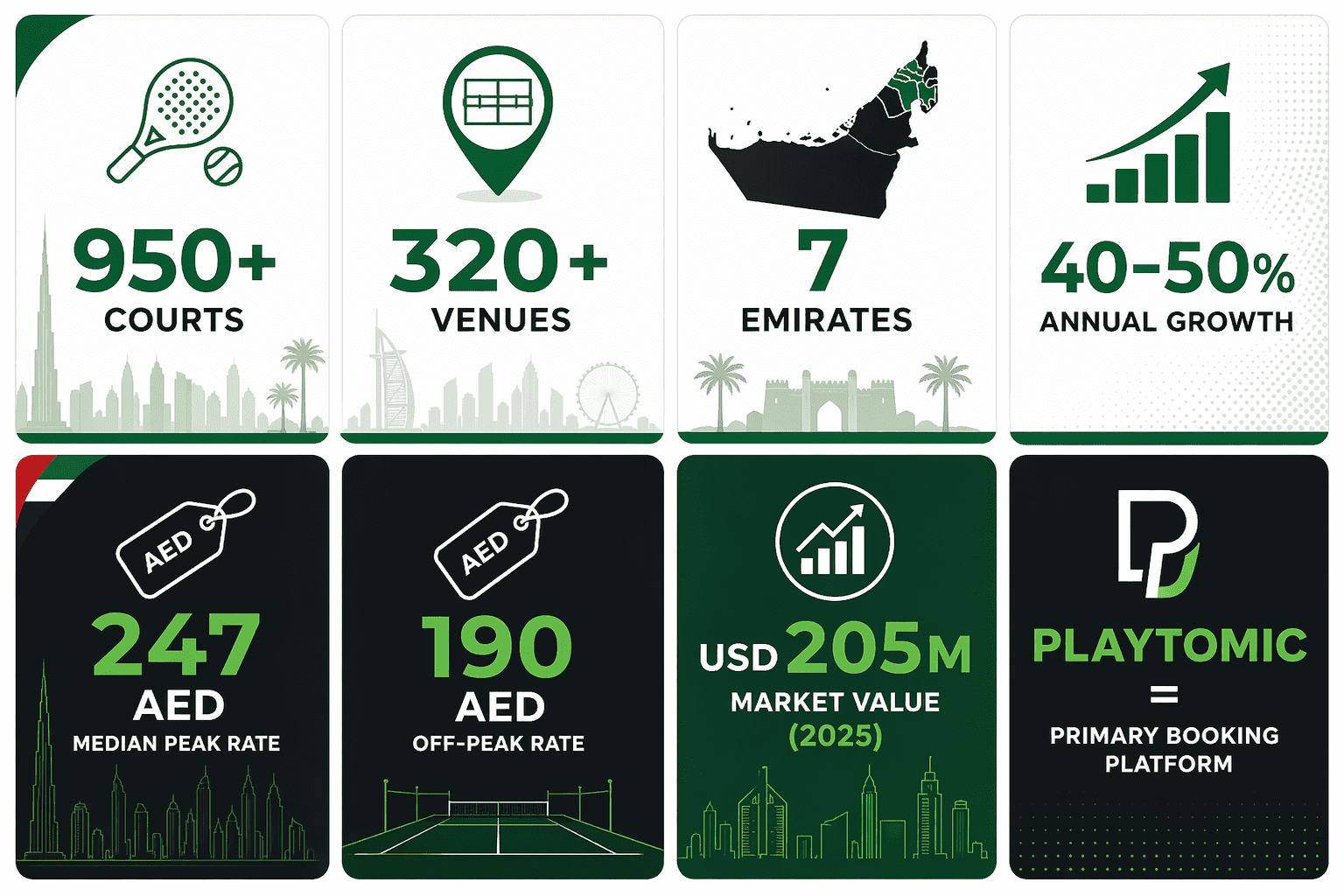
The UAE has 950+ padel courts across 320+ venues in all seven emirates as of 2026. Participation has grown an estimated 40-50% annually in recent years. Dubai holds the largest share of courts, followed by Abu Dhabi. Indoor courts dominate due to the climate, and Playtomic is the primary booking platform used across venues.
Key Padel Statistics: UAE 2026 Summary
- Total courts: 950+ (all seven emirates)
- Total venues: 320+
- Estimated annual participation growth: 40-50% (industry reports)
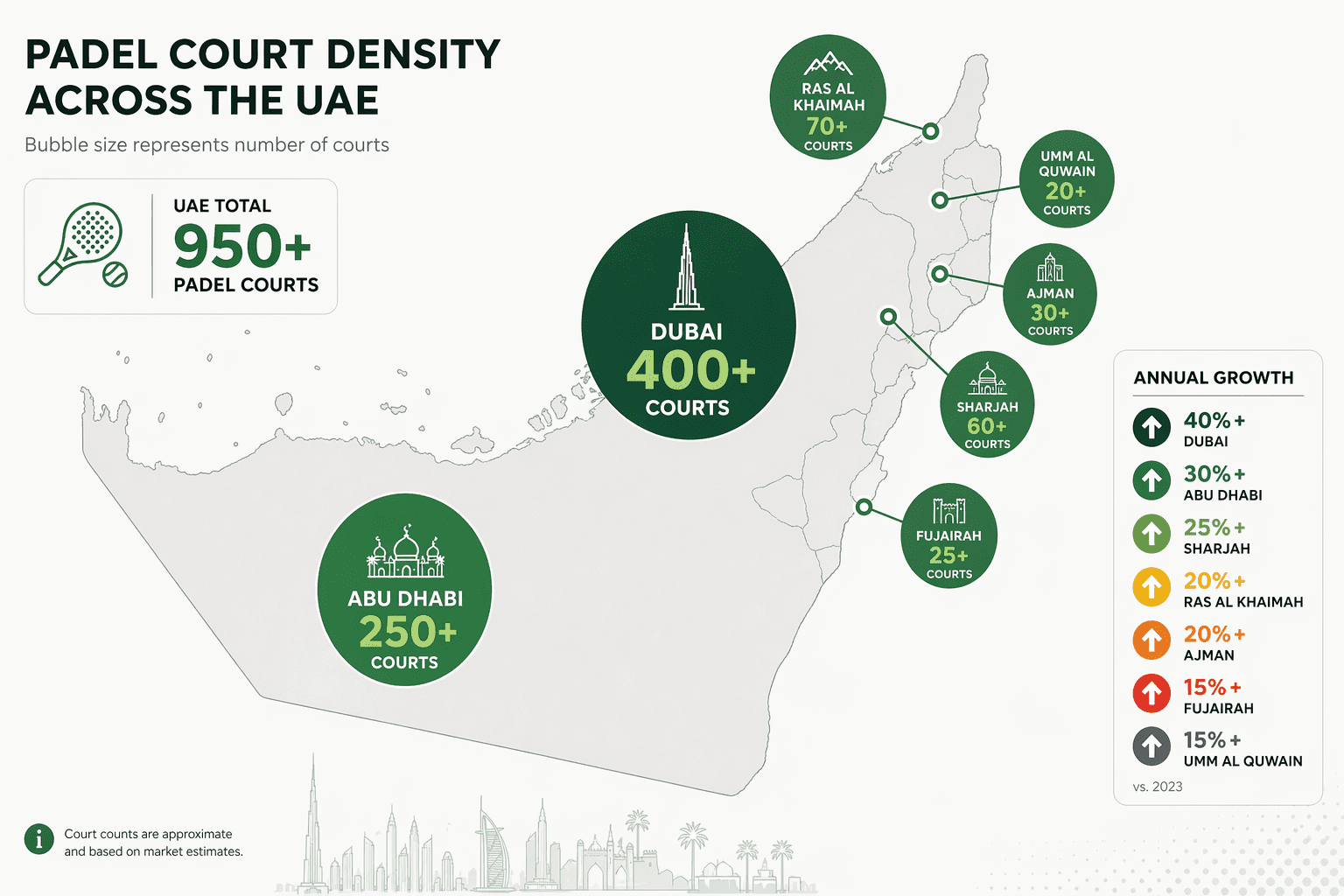
- Primary emirate: Dubai (400+ courts across Al Quoz, JVC, Business Bay, Dubai Hills, and other districts)
- Second emirate: Abu Dhabi (rapidly expanding, multiple indoor and outdoor venues)
- Court density: UAE ranks among the highest court-per-capita markets in the Middle East
- Indoor vs outdoor: Indoor and climate-controlled courts are the dominant format, essential from June to September when outdoor temperatures regularly exceed 40°C
- Booking platform: Playtomic is the most widely used platform for court reservations across the UAE
- Median peak court rate: 247 AED per hour (Padelnomics, March 2026)
- Median off-peak court rate: 190 AED per hour (Padelnomics, March 2026)
- UAE padel market value: USD 205 million in 2025 and USD 437 million by 2034 (commercial market research projection, Deep Market Insights; covers equipment and gear, not court operations or coaching revenue)
- Peak play windows: Early mornings (before 9am) and evenings (after 7pm) during hotter months; midday outdoor play feasible during November to April
The 950+ courts and 320+ venues figure is the Padel Gameplan editorial aggregate, cross-referenced against Playtomic UAE, MyPadelWay, Emirates Padel, and individual club websites across all seven emirates. Platform-specific directories such as Padelnomics (296 venues via Playtomic listings) and MyPadelWay (184 listed UAE venues) reflect only venues registered on each respective platform and understate the true total. All figures reflect the position as at April 2026 and are subject to ongoing change as the market expands.
Padel Courts in the UAE: Emirates Breakdown
Dubai
Dubai holds the largest concentration of padel courts in the UAE, with 400+ courts spread across venues from Al Quoz to JVC, Business Bay, and Dubai Hills. Al Quoz has historically served as the core padel hub, with multiple large multi-court facilities clustered in the industrial area. Court growth in Dubai has been driven by standalone padel clubs, hotel and resort facilities, residential community courts, and large multi-sport complexes.
Court counts in Dubai have increased substantially year-on-year, with estimates from industry observers suggesting participation and infrastructure have expanded by 40-50% annually in recent years. Many new venues have opened within luxury residential developments and lifestyle destinations, reflecting the sport’s transition from standalone club activity into integrated community infrastructure.
Abu Dhabi
Abu Dhabi’s padel scene has grown steadily alongside Dubai’s, with a mix of indoor clubs, hotel courts, and community-based facilities. Abu Dhabi offers competitive court pricing and accessible venues, making it a strong option for players based between Dubai and Sharjah. Key venues include Let’s Padel in Mussafah, Abu Dhabi Country Club, and Ritz-Carlton padel courts, among others. The emirate’s strong indoor infrastructure supports year-round play.
Northern Emirates and Beyond
Sharjah, Ras Al Khaimah, Ajman, Fujairah, and Umm Al Quwain all have established and growing padel court options. Ras Al Khaimah offers outdoor courts set against the Hajar Mountains. Fujairah provides a coastal playing environment on the east coast. These markets remain less densely saturated than Dubai and Abu Dhabi, making them areas of significant near-term growth potential for both operators and players seeking value court fees and less congested booking windows.
Padel Growth Rate UAE: Historical and Current Trends
Padel in the UAE has transitioned from a niche recreational activity into a mainstream sport and lifestyle phenomenon over the past decade. Introduced in the early 2010s, it saw its first exposure through private venues and social events, and by the mid-2020s it accelerated sharply. Reported growth rates show participation and infrastructure expanding by 40-50% annually in recent years.
Several factors are driving this growth rate.
Accessibility and social format
Padel’s doubles-only format, smaller court size, and wall-assisted play make it easier to learn than tennis. Globally, padel has a 92% return rate representing individuals returning to play after their first try, according to Playtomic’s Global Padel Report 2025, attributed to the sport’s accessibility, social nature, and addictive qualities. UAE-specific return rate data is not separately published.
Climate infrastructure investment
The UAE’s investment in indoor and climate-controlled padel courts has removed one of the most significant barriers to year-round play. Indoor padel courts are essential from June to September when outdoor temperatures exceed 40°C. Venues that offer air-conditioned indoor facilities consistently attract higher booking volumes during summer months.
Expat and community demand
A significant driver of padel’s popularity in the UAE has been the large expatriate population, especially from countries where padel is historically popular such as Spain and Argentina. These players brought familiarity with the sport and helped form clubs, social leagues, and mixed-level events that have expanded participation rapidly.
Digital infrastructure
Platform-based booking through Playtomic, combined with active WhatsApp groups and social media communities, has reduced friction for new players trying to find courts and partners.
Reasons for Padel Growth in the UAE
| Emirate | Padel Growth Trend | Market Activity |
|---|---|---|
| Dubai | Very High | Largest concentration of clubs and indoor courts |
| Abu Dhabi | High | Strong growth in premium sports facilities |
| Sharjah | Growing | Increasing interest among families and beginners |
| Northern Emirates | Emerging | New clubs and resort-based padel facilities appearing |
UAE Padel Market Size and Economic Outlook
According to commercial market research published by Deep Market Insights, the UAE padel product market – covering rackets, balls, footwear, and apparel – is estimated at USD 205.41 million in 2025 and projected to reach USD 437.56 million by 2034, at a CAGR of 8.67%. These are market research projections rather than official government or federation figures, and should be read accordingly.
In 2025, the UAE represented approximately 5.27% of the overall global padel market size. Across the Middle East and Africa region, the UAE is anticipated to hold the dominant market position by 2034. Saudi Arabia is identified as the fastest-growing market within the region, projected to reach USD 162.8 million by 2034.
These figures cover the padel product market only. They do not capture court construction revenue, venue operations, or coaching income, which represent additional and substantial segments of the broader UAE padel economy.
Global Padel Search Interest: Where the UAE Fits
Global search interest in padel grew 1,026% between 2004 and 2025, comparing annual averages. Virtually all of that growth is concentrated in the last five years. Worldwide interest rose 49% in the last 12 months versus the previous 12 months, according to the World Padel Network Global Search Report 2026.
In September 2025, padel hit the highest level of worldwide search interest ever recorded. Early 2026 data show Google Trends index scores of 89, 93, and 96 out of 100 for January, February, and March respectively – above any equivalent period in previous years.
Year-on-year search interest growth has compounded consistently: +63% in 2021, +15% in 2022, +21% in 2023, +19% in 2024, and +42% in 2025. The UAE is identified among high-growth markets globally alongside the UK, India, Indonesia, and others. Six countries entered the global top 20 for padel search interest for the first time in the most recent reporting period, reflecting the sport’s continued geographic diversification beyond its traditional European and Latin American heartlands.
UAE Padel in a Global Context
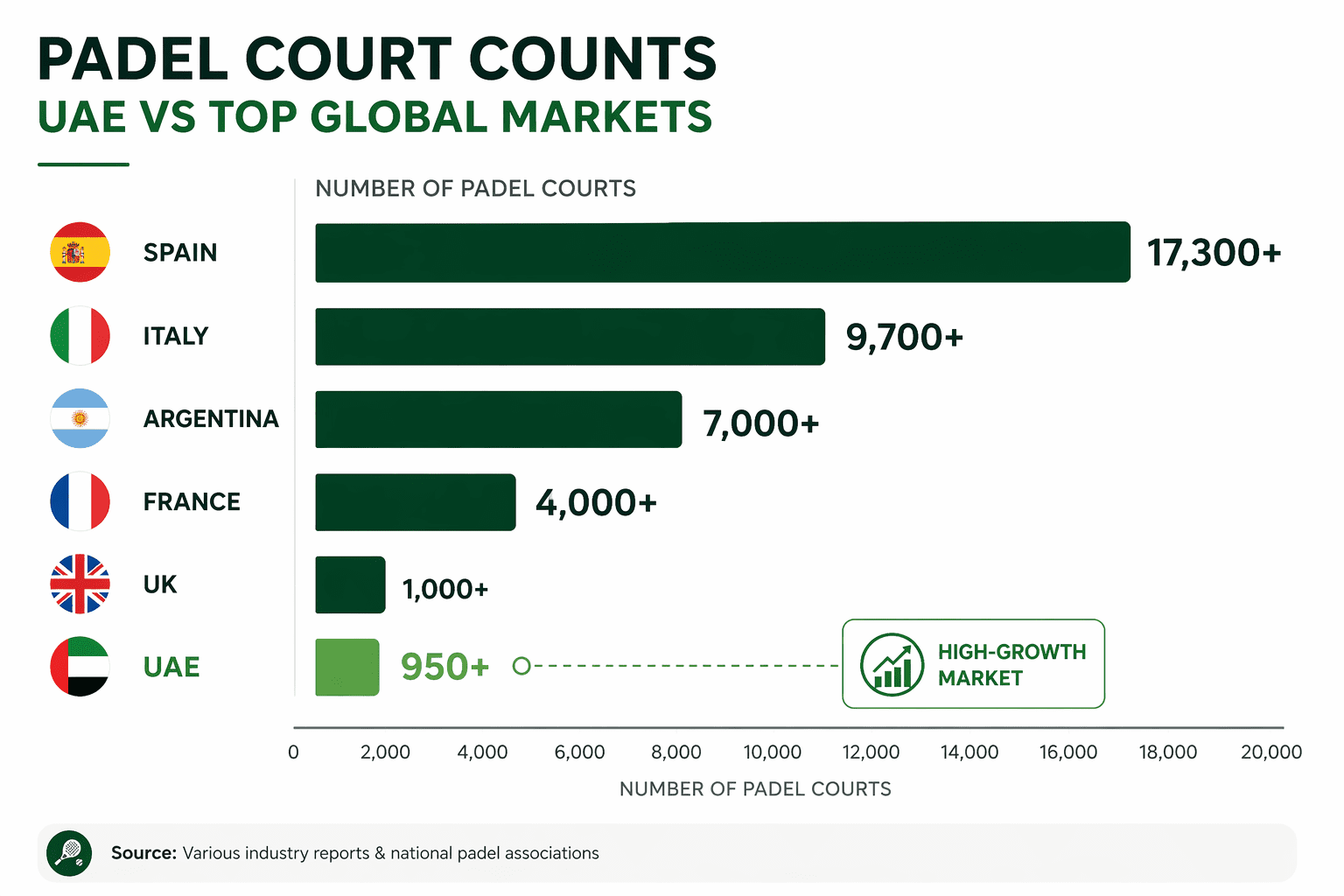
Globally, there are now 77,300+ padel courts spread across 24,600+ clubs, with Europe hosting approximately 65% of the total, according to FIP and Tennis Creative data as at end-2025.
There are now more than 35 million padel players around the world, according to FIP estimates. Approximately 60% of players are in Europe, 23% in South America, 7% in Central and North America, 6.4% in Asia, 4.3% in Africa, and 0.3% in Oceania.
FIP has noted that padel is booming not only in the Middle East – UAE, Saudi Arabia, Kuwait, and Qatar – but also in Indonesia, Thailand, Pakistan, and China. High-growth markets identified in Playtomic’s Global Padel Report 2025 include Portugal, the Netherlands, USA, UK, UAE, Mexico, India, and Indonesia.
The GCC combined figure of 1,850 courts across 600 venues is drawn from a 2024 industry report and should be treated as a baseline rather than a current figure, given the pace of regional expansion since that date. With the UAE alone now at 950+ courts, the current GCC combined total is likely materially higher.
Padel Player Demographics in the UAE
Age Profiles
Padel attracts a wide age range across the UAE. Young adults and professionals in their 20s-40s form much of the core regular playing population, often participating in leagues, weekend matches, and social group play. Teen and youth programmes have increased as academies introduce padel to schools and training camps. Older adults and families are also drawn to the sport for its lower physical impact compared with high-intensity alternatives.
Gender Participation
According to FIP, most amateur players globally are men, at around 60%, with women accounting for approximately 40% of the total player base – making padel one of the most gender-balanced racket sports in the world. This figure reflects the global average; UAE-specific gender participation data is not separately published. UAE venues increasingly offer women-only sessions and female-focused coaching programmes, reflecting growing local demand from that segment.
Expat vs Local Participation
While padel’s early growth in the UAE was propelled by expats, participation among Emiratis and Arabic residents has grown steadily, supported by federation initiatives, family tournaments, youth programs, and broader exposure through lifestyle media.
Beginner vs Intermediate Split
Based on community feedback and the pace of venue growth in the UAE, the market is broadly characterised as primarily beginner and early-intermediate in composition. No published UAE-specific participation data by skill level is available; this reflects editorial assessment informed by club-level observation. Intermediate and advanced club leagues are growing but are understood to represent a smaller proportion of overall court usage at present.
Junior and Kids Padel Growth in the UAE
Junior padel is one of the most significant areas of growth in the UAE market. Multiple academies have expanded or launched structured junior programmes in recent years, including:
- Emirates Golf Club Junior Padel Programme (ages 5-15)
- Viya Padel Junior Group Programme (structured 8-week coaching)
- Central Padel Dubai Junior Academy (ages 4-16)
- WPA Junior Padel Academy (ages 4-15)
- McDonald’s Junior Padel Academy (ages 8-12, operating across Dubai, Abu Dhabi, and Sharjah)
This list reflects established programmes confirmed through academy websites and is representative rather than exhaustive. Additional junior programmes operate across UAE venues; players and parents are advised to verify current availability, scheduling, and pricing directly with each academy.
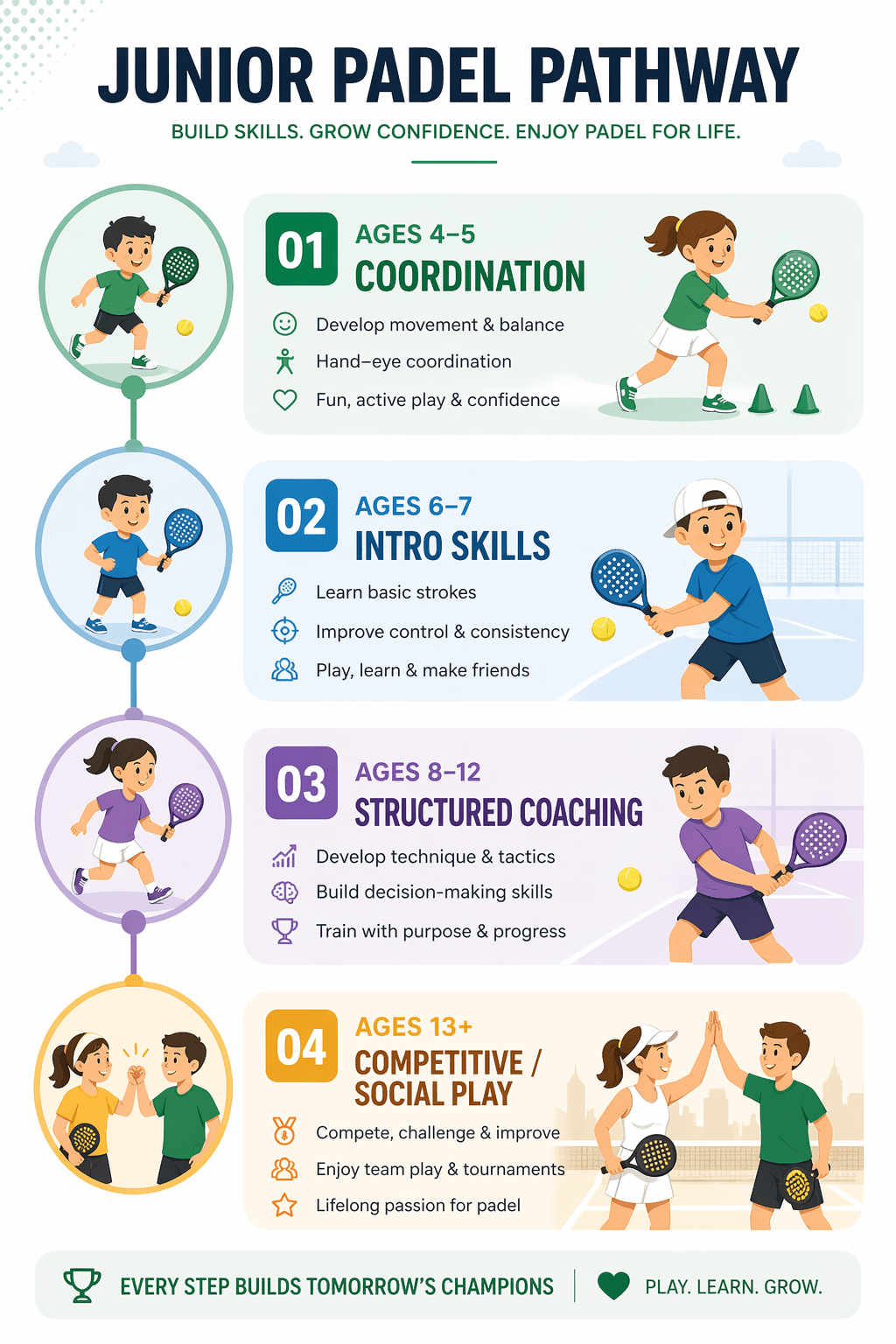
Children can begin learning padel at very young ages, with most junior programmes starting around 4-5 years for basic physical coordination and racket familiarity, 6-7 years for introductory padel skills, and 8+ years for structured coaching with basic technique and game play.
Parents commonly report choosing padel over other racket sports for younger children because of the smaller court dimensions, wall-assisted rallies, and the doubles format that encourages social participation from the outset. The UAE’s growing number of after-school programmes and school-holiday camps reflects this demand directly.
Booking, Pricing, and Playing Trends in the UAE
Court Pricing
Based on live Playtomic data compiled by Padelnomics in March 2026, the median peak court rate across UAE venues is 247 AED per hour, with off-peak rates at approximately 190 AED per hour. The spread between peak and off-peak rates reflects the practical cost advantage available to players who book outside peak windows.
Pricing varies significantly by emirate and venue type. Venues across Sharjah and the Northern Emirates typically offer lower rates, with community-reported figures ranging from approximately 160 AED to 240 AED per court per hour. Premium and hotel-based courts in Dubai can exceed 380 AED per hour at peak times. Since padel is played in doubles with four players per court, the per-player cost is significantly lower than the headline court fee. Readers should verify current pricing directly with venues as fees are subject to change.
Peak Playing Windows
UAE padel playing behaviour is shaped primarily by climate:
- October to April: Peak outdoor and mixed-format play. Both morning and evening slots are popular. Weekends see the highest court demand, and advance booking is commonly advised at popular venues.
- May to September: Indoor courts dominate. Early morning (6am-9am) and evening (after 7pm) slots see the highest demand. Midday outdoor play is largely impractical due to heat.
Platform-Based Booking
Playtomic is the most widely adopted platform for court reservations across UAE venues. Many clubs also offer direct WhatsApp booking or their own website-based reservation systems. The Playtomic app allows players to compare available slots and prices across multiple venues simultaneously and to join open matches, which reduces the barrier for new players without an established group.
Session Duration and Format
Most recreational sessions are booked in 60-minute or 90-minute slots. Group social bookings – typically four players sharing a court – remain the dominant format. Coaching sessions and drills-based clinics represent a growing proportion of weekday daytime bookings across major academies.
UAE vs Middle East Padel Comparison
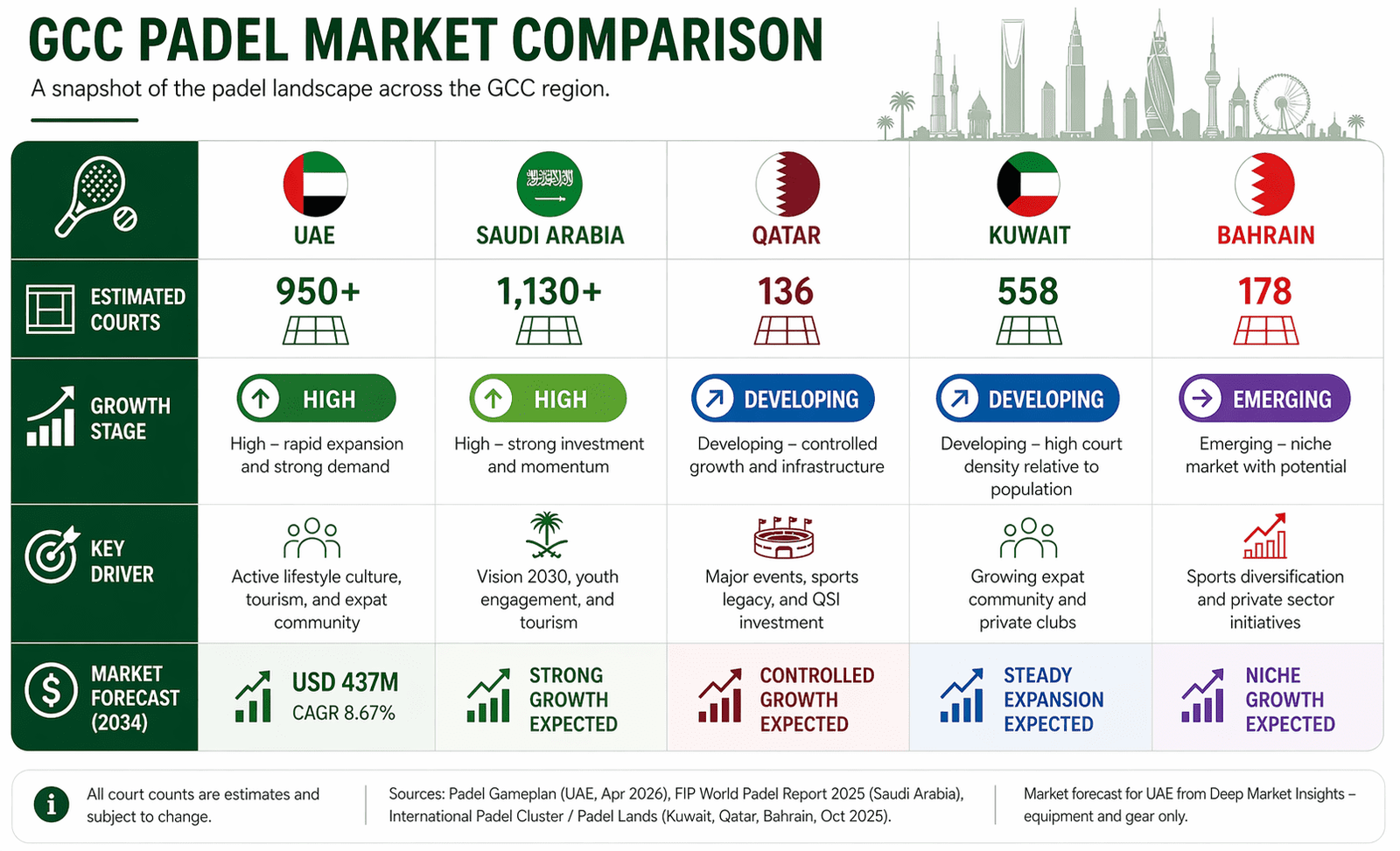
The UAE holds one of the highest court density in the GCC and is forecast to maintain the dominant position in the Middle East and Africa padel market by 2034. Saudi Arabia’s market with the highest and is expanding rapidly, supported by Vision 2030 investment in sports infrastructure and the hosting of Premier Padel events. Qatar has leveraged its sports investment infrastructure through the backing of Qatar Sports Investment, while Kuwait and Bahrain have smaller but established padel scenes.
The GCC combined figure of 1,850 courts across 600 venues is drawn from a 2024 industry report and should be treated as a baseline estimate. Given the pace of regional expansion since that data was published, the current GCC combined total is likely materially higher.
The UAE’s advantages over regional peers include the depth of its expat population with existing padel familiarity, the maturity of its indoor venue infrastructure, the established presence of platform-based booking ecosystems, and the longest runway of community-level padel culture in the region.
UAE vs Middle East vs Global: Padel Growth Comparison Table
| Region | Estimated Courts | Growth Stage | Key Driver |
|---|---|---|---|
 UAE UAE | 950+ (April 2026) | High – rapid expansion and strong demand | Active lifestyle culture, tourism, and expat community |
 Saudi Arabia Saudi Arabia | 1,130+ | High – strong investment and momentum | Vision 2030, youth engagement, and tourism |
 Kuwait Kuwait | 558 | Developing – high court density relative to population | Growing expat community and private clubs |
 Qatar Qatar | 136 | Developing – controlled growth and infrastructure | Major events, sports legacy, and QSI investment |
 Bahrain Bahrain | 178 | Emerging – niche market with potential | Sports diversification and private sector initiatives |
 Spain Spain | 17,300+ | Mature / stable | Domestic culture and federation depth |
 Italy Italy | 9,700+ | High | European expansion |
 Argentina Argentina | 7,000+ | Stable | Historic padel culture |
 France France | 4,000+ | High (+55% in 18 months) | Urban club investment |
 UK UK | 1,000+ | Very high (+121% search interest) | LTA support and tennis crossover |
 Global Global | 77,300+ | Accelerating – approx. 26% court growth in 2024 | Worldwide diversification |