Why Padel Balls Lose Pressure
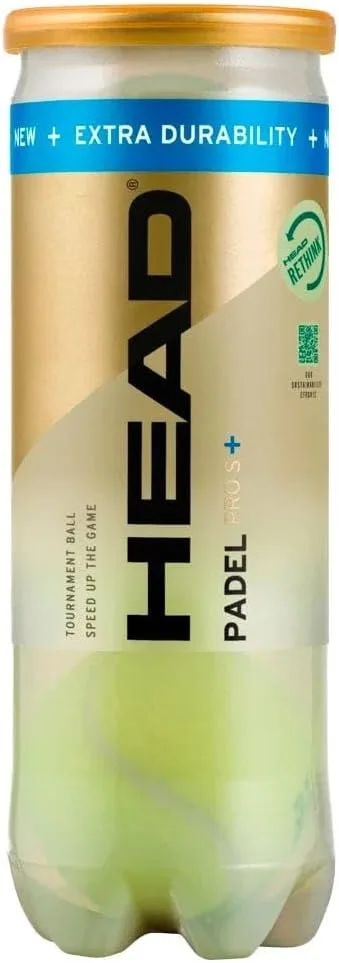
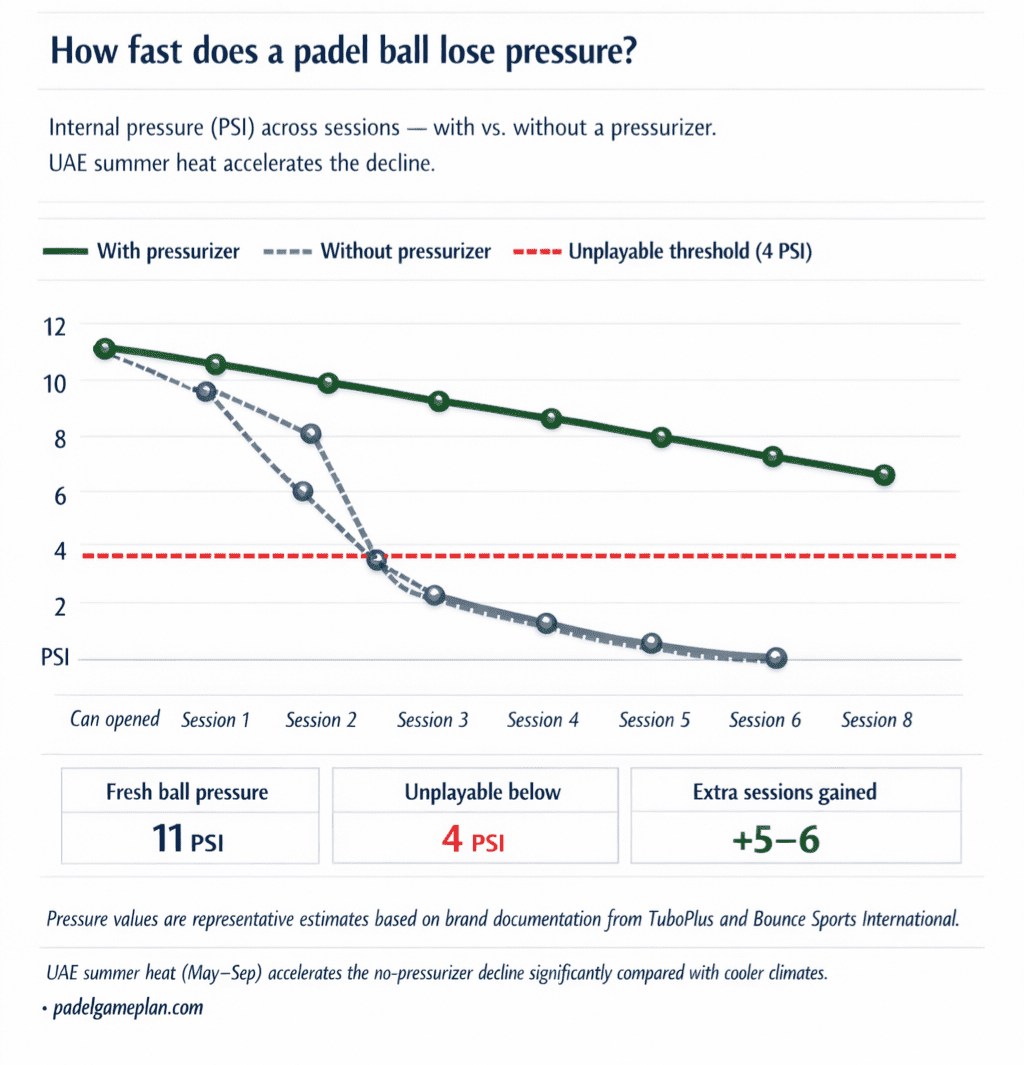
Every padel ball is a pressurised rubber shell. Fresh from the factory, the internal pressure sits at approx. 10-11 PSI – the level that produces the speed, bounce height, and response players expect from a well-performing ball.
The rubber that creates this shell is not perfectly airtight. It is slightly porous, and air migrates outward constantly, even in an unopened can. The pressurised environment inside the sealed can slows this process dramatically – which is why a fresh can from the shelf still performs well even if it has been sitting in a warehouse for months. The moment the can is opened, that protective environment is gone.
From that point, pressure loss is continuous. Playing accelerates it – the deformation of the ball on each strike and wall impact forces air through the rubber at a faster rate. Temperature accelerates it further. In the UAE, where ambient temperatures between May and September regularly exceed 40°C, a ball left in a car, an outdoor bag, or an unshaded court-side bench can lose meaningful pressure within a single session.
The felt surface compounds the problem. As felt wears, the aerodynamic profile of the ball changes, affecting flight and pace regardless of internal pressure. This is why a ball can still hold pressure but feel wrong – the rubber is intact but the felt has given up.
Flat vs Pressurized Padel Balls
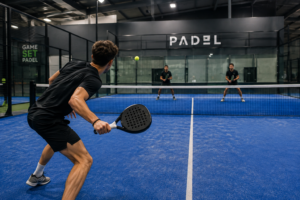
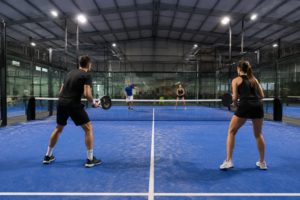
These images show the difference in feel between flat and pressurized padel balls.

Without Bounce
A flat padel ball can feel softer, lower, and less responsive during play.

With Bounce
A pressurized padel ball can feel firmer, livelier, and more consistent on court.
How a Padel Ball Pressurizer Works
| Action | Preservation Model | Restoration Model |
|---|---|---|
| How it works | Compresses air already inside the tube via screw or twist | Pumps additional air into the chamber above factory pressure |
| Pressure reached | approx. 14-16 PSI | approx. 24-29 PSI |
| Can it stop pressure loss? | Yes | Yes |
| Can it recover flat balls? | No | Partially – if recently flat |
| Pump required? | No | Yes – integrated or external |
| Best for | Players who store balls immediately after every session | Players whose balls sometimes go flat before the next session |
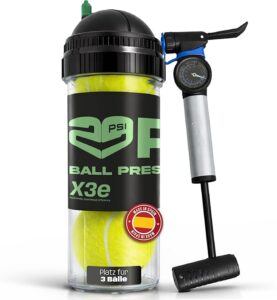
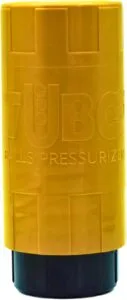
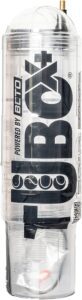
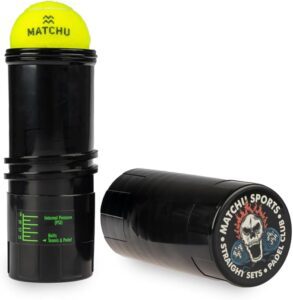
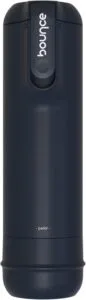
| Examples | TuboX3, Matchu Pressure Pro | Bounce Tube Padel, TuboPlus 29PSI |
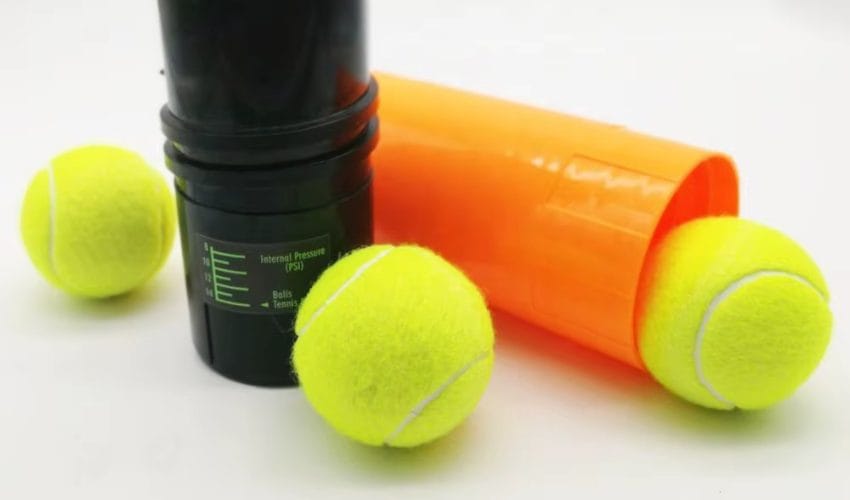
A padel ball pressurizer creates a sealed environment around the ball where the air pressure is maintained at or above the pressure inside the ball. The physics are simple: air moves from high pressure to low pressure. If the environment surrounding the ball is kept at equal or higher pressure, the ball cannot lose air outward. Pressure loss stops.
Preservation models – which use a screw or twist mechanism to compress the air already inside the tube – typically reach approx. 14-16 PSI on full closure. This is sufficient to hold the line on a ball that still has reasonable pressure, preventing further loss between sessions.
Restoration models go further. By using an integrated or external pump to push the chamber above factory pressure – some reaching 24 to 29 PSI – they create a reversed pressure differential. Air gradually diffuses back into the ball over 24-72 hours, partially recovering pressure that had already been lost. This is not instantaneous, and it is not unlimited – a ball that has dropped from 11 PSI to 4 PSI will recover some ground but is unlikely to return fully to factory condition.
Can a Pressurizer Restore Flat Balls
This is where most disappointment with pressurizers originates. Players purchase a restoration model expecting flat balls to emerge from the tube feeling like new. Some do – those that went flat relatively recently. Many do not – those that have been flat for days, or whose felt is too worn for pressure to matter.
The most useful way to think about it: a pressurizer is not a repair tool. It is a preservation tool that, in its more capable forms, has some recovery capability. The analogy that holds up in practice is a phone battery – a pressurizer is like keeping the phone plugged in so it never drops to zero. It is not a new battery.
Community feedback from regular padel players consistently reflects this. Players who store their balls in a pressurizer immediately after every session, without exception, report the best results – often extending ball life from two to three sessions without a pressurizer to six or more with one. Players who leave balls out for a day or two and then place them in a pressurizer report more modest results.
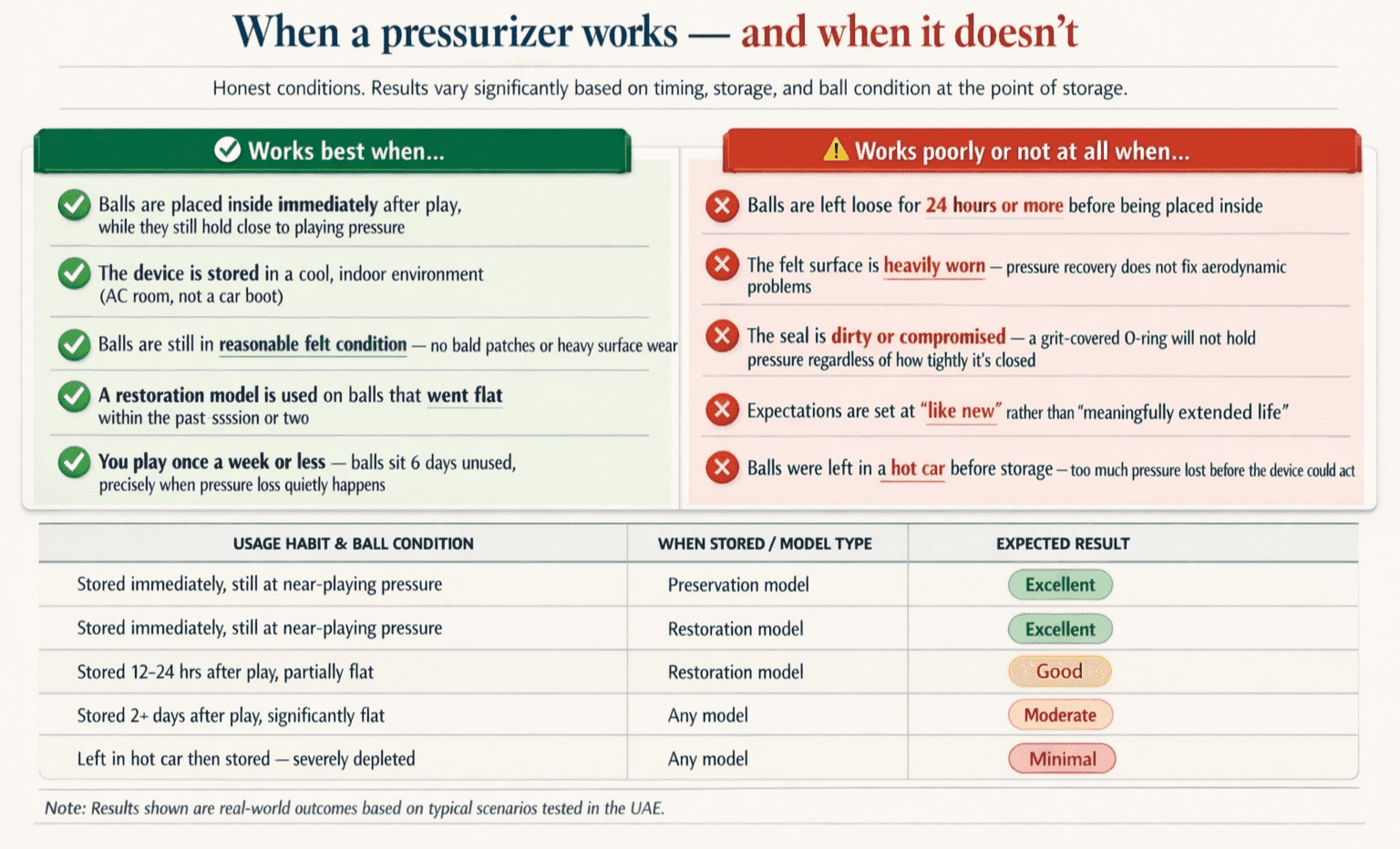
| Usage Habit | Ball Condition When Stored | Expected Result |
|---|---|---|
| Stored immediately after play, preservation model | Still at near-playing pressure | Excellent – ball holds condition across 6-8 sessions |
| Stored immediately after play, restoration model | Still at near-playing pressure | Excellent – ball maintained and partially enhanced |
| Stored 12-24 hours after play, restoration model | Partially flat | Good – meaningful recovery over 24-72 hours |
| Stored 2+ days after play, any model | Significantly flat | Moderate – some recovery but not to playing standard |
| Stored promptly, felt heavily worn | Pressure recoverable, felt is not | Poor – pressure returns but ball still plays flat |
| Left loose in hot car then stored | Severely depleted | Minimal – too much pressure lost before storage |
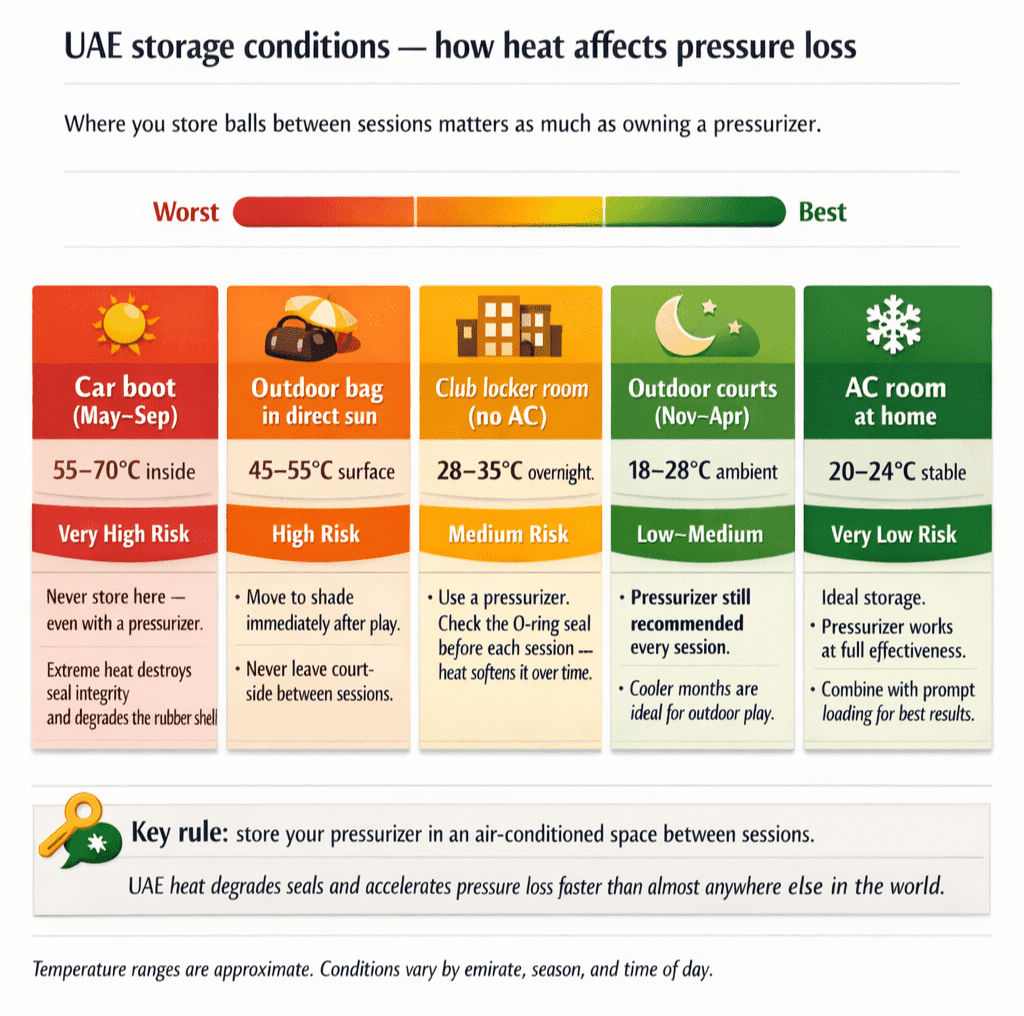
How UAE Heat Affects Padel Ball Pressure
Significantly, yes – and in ways that cut both ways.
Heat accelerates pressure loss. The molecular activity in warmer rubber increases, which means air passes through the shell faster. A ball left on a court bench in 38°C heat for two hours is in a measurably worse state than the same ball stored in an air-conditioned room. For UAE players, this means the gap between a ball stored with a pressurizer and one stored without is larger than it would be in a cooler climate. The benefit of the pressurizer is amplified.
However, heat also stresses the pressurizer itself. The O-ring or rubber seal in most pressurizer designs can degrade faster in sustained high-temperature storage. Leaving a pressurizer in a car or outdoor bag in peak UAE summer reduces its effectiveness and shortens the life of the seal. The practical guidance is straightforward: store the pressurizer in an air-conditioned space between sessions. The device protects the balls best when it is also being protected from the heat.
Indoor courts across Dubai, Abu Dhabi, and Sharjah provide a climate-controlled playing environment, which helps. But for players on outdoor or semi-covered courts in Ras Al Khaimah, Fujairah, Ajman, and Umm Al Quwain – particularly during the shoulder months when heat is present but outdoor play is still attractive – a pressurizer makes a more noticeable difference than almost anywhere else in the world.
When a Pressurizer Works and When It Does Not
It works best when:
- Balls are placed inside immediately after play, while they still hold close to playing pressure
- The device is stored in a cool, indoor environment between sessions
- Balls are still in reasonable felt condition – no bald patches or heavy surface wear
- A restoration model is used on balls that went flat within the past session or two
It works poorly or not at all when:
- Balls are left loose for 24 hours or more before being placed inside
- The felt surface is heavily worn – pressure recovery does not fix aerodynamic problems
- The seal is dirty or compromised – a cracked or grit-covered O-ring will not hold pressure regardless of how tightly the lid is closed
- Expectations are set at “like new” rather than “meaningfully extended”
Cost of Padel Balls vs Pressurizer in UAE
The financial argument for a pressurizer is one of the clearest in padel accessories.
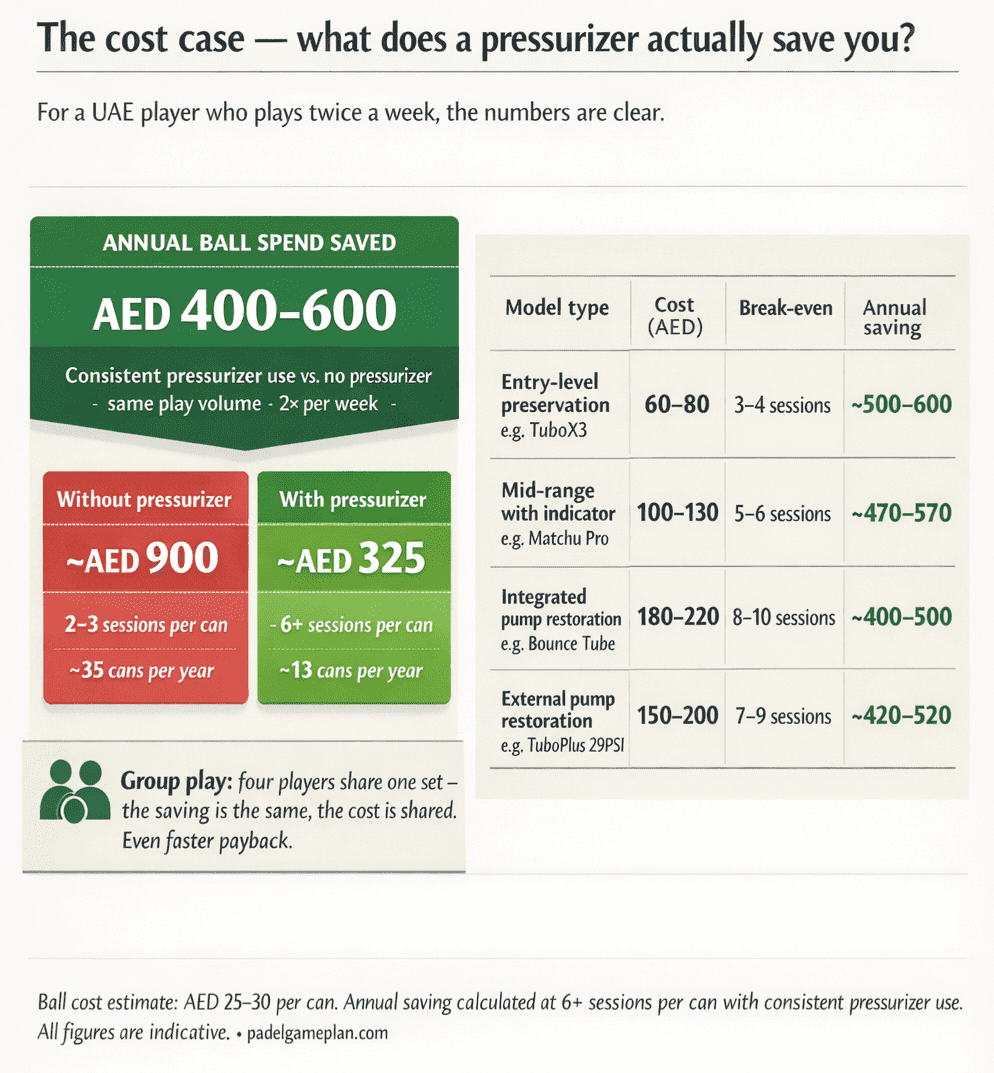
A standard can of padel balls costs approx. AED 25-30 at UAE clubs and retailers. A player who plays twice a week and replaces balls every two to three sessions spends approximately AED 800-1,000 on balls annually. With consistent pressurizer use extending ball life to six or more sessions, the same player might spend AED 300-400 on balls – a saving of AED 400-600 per year.
Even entry-level pressurizer models pay for themselves within two to three months for a regular player. For group play – where four players share a set of balls per session, which is the standard format across UAE club play – the saving is the same but the cost is shared across the group.
Which Padel Ball Pressurizer Type Suits Your Game
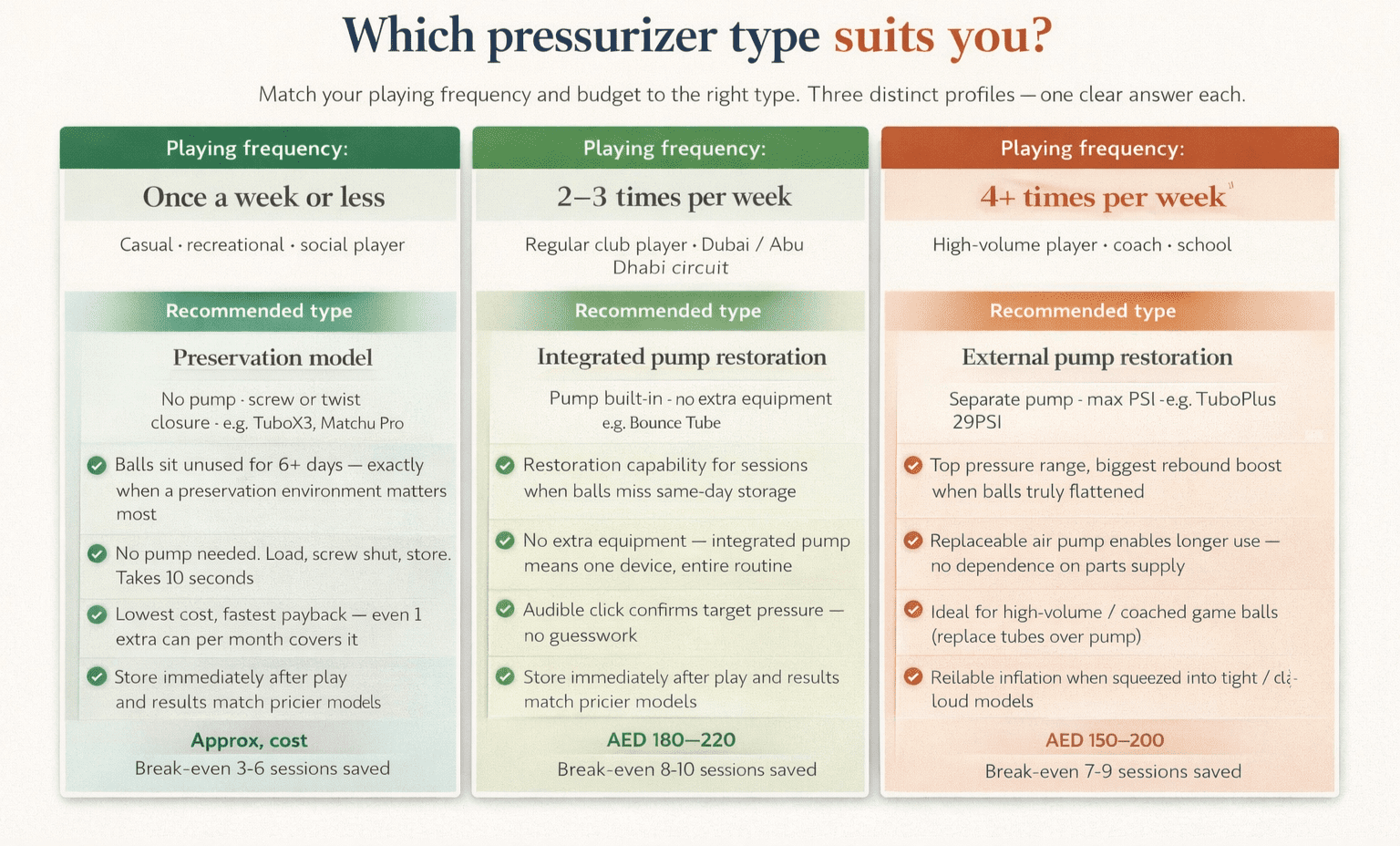
Three distinct types of pressurizer exist, each suited to a different kind of player.
Preservation-only models (no pump required, screw or twist closure) suit players who play once or twice a week and want a simple, low-effort habit. They require no additional equipment and take seconds to use. The trade-off is that they cannot recover pressure from balls that have already gone flat – they hold the line but do not push it back.
Integrated pump models (pump built into the device, no external equipment needed) suit regular players who want genuine restoration capability without carrying extra equipment. The integrated pump means the entire process – load balls, pump, click, done – takes under a minute court-side. These are the strongest all-round option for most active UAE players.
External pump models (separate pump required, higher maximum PSI) suit frequent players and coaches who want maximum restoration pressure and are willing to manage the additional equipment. The higher ceiling – some models reach 29 PSI – produces the strongest restoration effect on balls that have lost significant pressure.
For a detailed comparison of specific models available on Amazon.ae, including price ranges and a full breakdown of which suits each playing level, visit the Padel Gameplan guide to the best padel ball pressurizers in UAE 2026.
Best Padel Ball Pressurizers by Player Type
Some links below are affiliate links.
| Best Overall | Best for Beginners | Best for Club Players | Best Compact | Best Premium |
|---|---|---|---|---|