
For a complete overview of padel technique, beginner guides and skill development resources, visit the Learn Padel UAE hub. For structured drills that develop grip and other foundational skills, see the Padel Beginner Drills guide.
Why the Grip Matters in Padel
The grip is the only point of contact between the player and the racket. How the handle sits in the hand determines the angle of the racket face at contact, the stability of the wrist during fast exchanges, and the range of motion available for different shot types.
Padel is played at close range with glass and mesh walls in play on all sides. Rallies move quickly – particularly at the net – and there is rarely time to adjust hand position between shots. A grip that requires constant readjustment creates a delay that shows up as late volleys, missed blocks, and inconsistent contact on wall rebounds.
Coaches note that correcting bad grip habits is more difficult than teaching the correct grip from the start. A poor grip, once embedded as muscle memory, can limit a player’s ability to improve and is associated with increased injury risk and reduced shot precision. For this reason, UAE academy coaches across Just Padel, Club Padel Dubai, and Danube Padel Academy consistently introduce grip as the foundation of the first lesson.
For a complete guide to padel coaching programmes and kids classes across the UAE, visit the Padel Coaching UAE hub.
The Continental Grip: What It Is and Why It Is Recommended
The continental grip is the standard starting grip in padel and the grip used as the default hand position by high-level players for the majority of shots – including volleys, serves, overheads such as the bandeja and vibora, and defensive play off the glass walls.
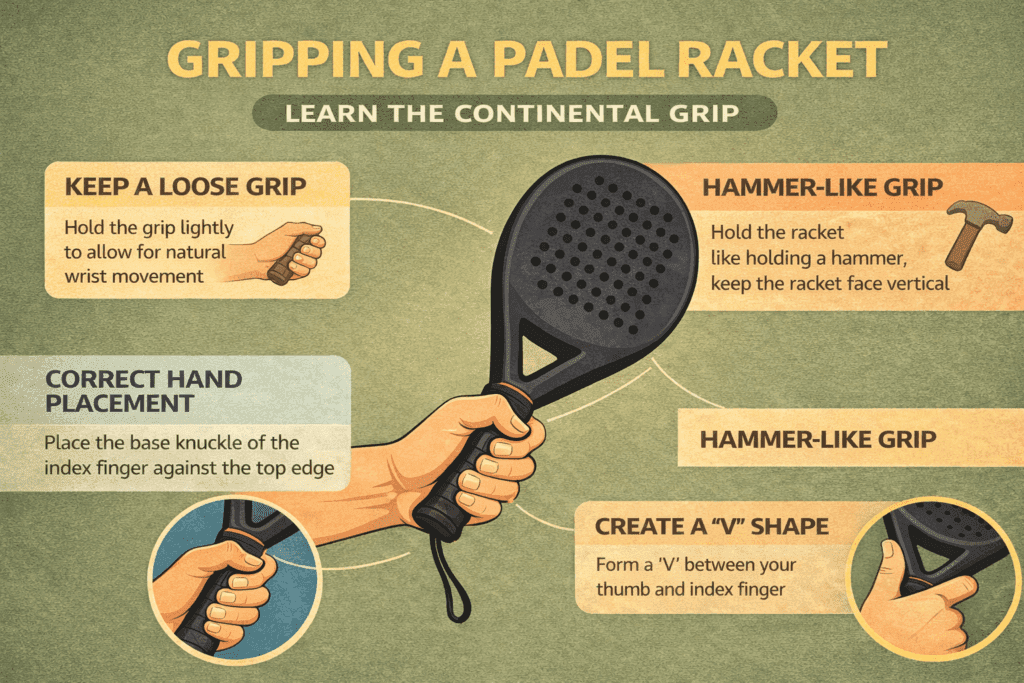
It is commonly called the “hammer grip” because the hand position resembles the natural way a person would hold a hammer to drive a nail. This analogy is widely used by coaches as an easy reference point for beginners finding the position for the first time.
The continental grip is a neutral position that sits between forehand and backhand hand positions. Rather than rotating the hand for different shots, the player keeps one reliable grip and adjusts the racket face, contact point, and footwork. In padel – where rallies are fast and rebounds off glass arrive quickly – this gives consistency and speed.
Coaches commonly describe it as a foundational grip: one that allows players to execute forehands, backhands, volleys, serves, and overheads without needing to switch positions mid-rally. This versatility is particularly valuable in game situations where reaction time is limited.
How to Find the Continental Grip
The following steps reflect the method used by coaches across UAE padel academies. Coaches recommend checking this sequence every time a player steps onto the court until the position becomes automatic.
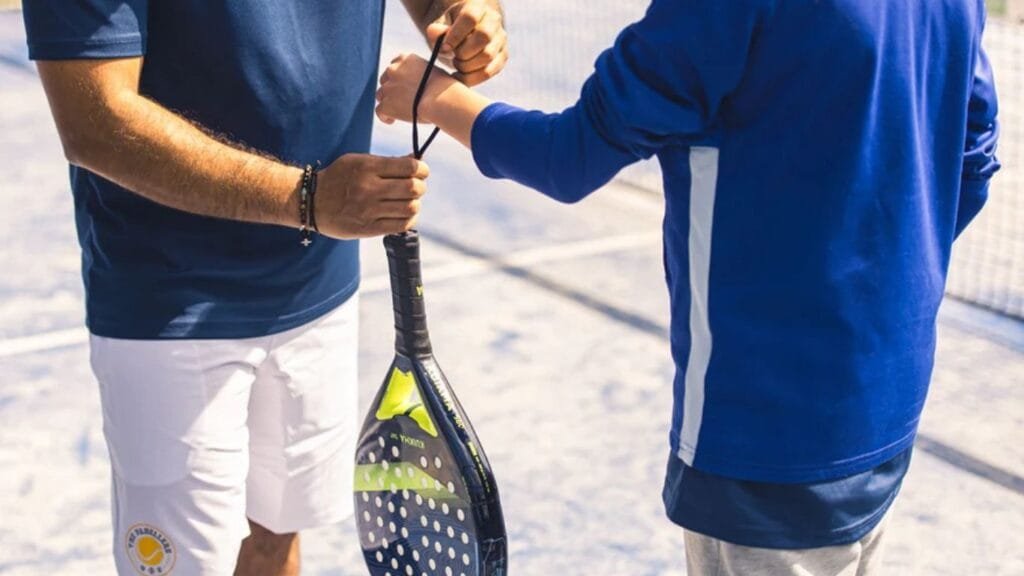
Step 1 – Attach the safety strap. Before holding the handle, slide the wrist strap over the dominant hand and ensure it sits securely. The strap prevents the racket from flying loose during play and is a basic safety requirement at all UAE padel venues.
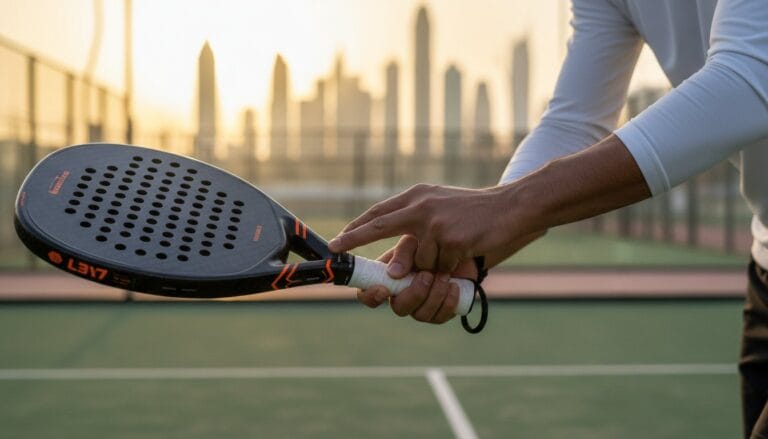
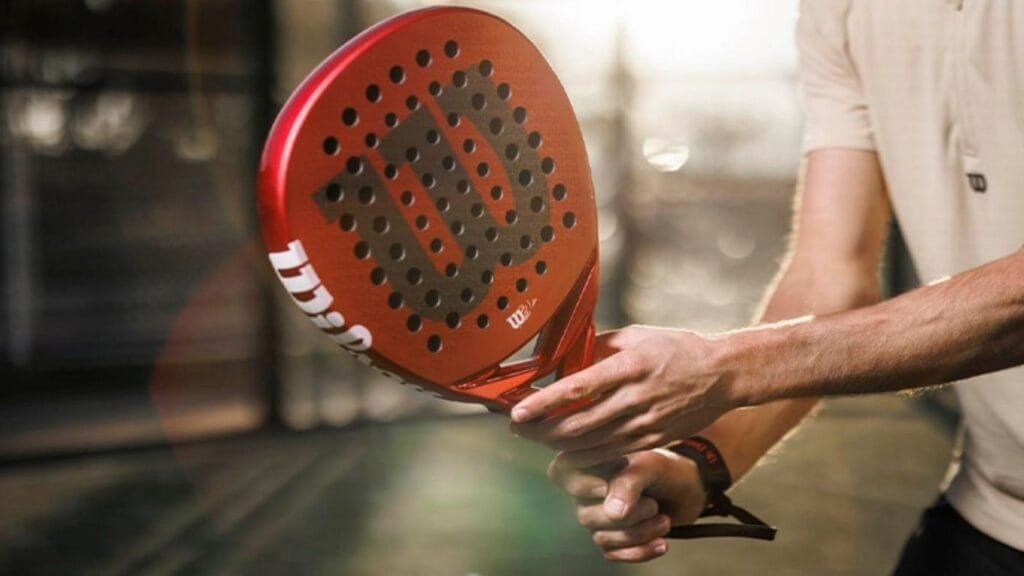
Step 2 – Hold the racket by the throat. Using the non-dominant hand, hold the racket by its frame (the throat area) with the face perpendicular to the ground – that is, the hitting surface pointing sideways, not upward or downward.
Step 3 – Shake hands with the handle. Extend the dominant hand toward the handle as if offering a handshake. This natural handshake position is close to the correct continental grip and is one of the most common teaching methods used by coaches.
Step 4 – Find the correct bevel. The handle of a padel racket is octagonal, with eight bevels (flat sides) numbered around the frame. The base knuckle of the index finger should rest on bevel 2 – the top bevel of the handle for right-handed players. The thumb rests flat against the back of the handle. Left-handed players mirror this position on the opposite side.
Step 5 – Check the V shape. The V formed between the thumb and index finger should sit on the top bevel of the handle. Two reliable reference points for a correct continental grip are the base knuckle of the index finger and the heel pad (the fleshy base of the palm), both contacting the top bevel area. This prevents the grip from drifting into a tennis-style forehand position during fast rallies.
Step 6 – Wrap the fingers naturally. Fingers should wrap around the handle without being clenched tightly or extended stiffly. The thumb rests comfortably along the back or side of the handle. A small, relaxed gap feeling in the palm improves touch and wrist mobility.
Step 7 – Slide the hand to the base. The heel of the hand should sit flush with the bottom of the grip. Holding too high up the handle reduces reach and power; holding too low creates instability.
Grip Pressure: How Tight to Hold
Grip pressure is one of the aspects of holding a padel racket that beginners most commonly get wrong – typically by holding too tightly throughout play.
Holding the racket with excessive constant tension causes forearm fatigue to set in earlier in a session, reduces the sensitivity of touch shots at the net, and limits wrist mobility for low defensive balls. This is particularly relevant in the UAE’s warm climate, where sessions in even air-conditioned indoor courts involve sustained physical effort.
Coaches commonly recommend moderate grip pressure during rallies – relaxed enough for touch and wrist mobility – with a brief increase in firmness at the moment of ball contact. The goal is consistent, moderate tension that can be briefly increased at impact rather than maintained at maximum throughout a point.
A useful self-check during a session: if the hand feels fatigued within the first 30 minutes of play, grip pressure is likely too high for most of the point.
Checking the V: A Self-Correction Method During Play
The V reference between the thumb and index finger gives players a reliable visual cue they can use to self-check grip position at any point – during a changeover, before a serve, or in a break between points.
Players who have come from a tennis background often find that their hand drifts back toward a forehand-dominant position during fast rallies, particularly when under pressure. Resetting the racket with the non-dominant hand to check V position during breaks in play is a method coaches commonly suggest while grip muscle memory is still being established.
Why Tennis Grips Create Problems in Padel
Players transitioning from tennis sometimes carry their existing grip habits onto the padel court. The Eastern and Western forehand grips used in tennis are designed for heavy topspin shots from a distant baseline. In padel, where play is compact and net exchanges are frequent, these grips create practical problems.
A strong closed-face forehand grip makes it difficult to open the racket face for the slice and backspin-based shots that form a large part of defensive and wall-play technique in padel. It also affects volleys, where a neutral face angle is needed for reliable contact. The continental grip keeps the racket face stable so players can block, volley, and defend without needing to switch hand position during a rally.
Players from a squash background often find the transition to the continental grip more straightforward, as the two sports share similar principles around compact swings and wall-play technique.
Grip Adjustments for Specific Shots
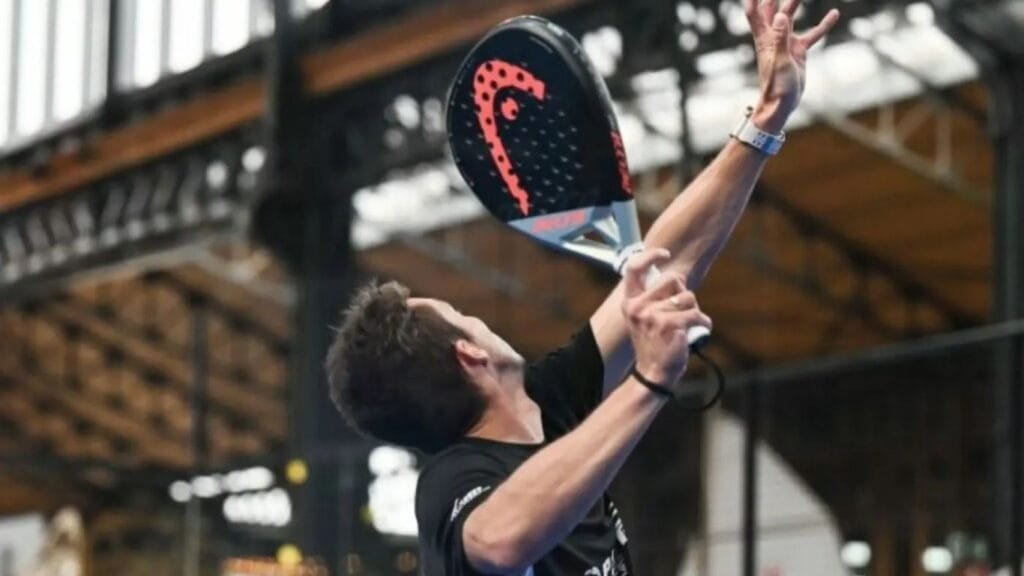
The continental grip is the recommended starting and default position. As players develop beyond beginner level, coaches may introduce small adjustments for specific situations. These are minor rotations rather than full grip changes, and coaches typically advise players to have logged consistent practice time with the standard continental grip before experimenting with adjustments.
Bandeja and vibora: Most coaches recommend maintaining a standard continental grip for overhead shots including the bandeja. The consistent face angle provides reliable control when keeping the ball deep from the net position.
Defensive play off the back glass: When retrieving low balls in the back corners, some players find a slight upward shift of the hand along the handle – shortening the effective length of the racket – provides better maneuverability in confined spaces. This is a practical adjustment for tight situations rather than a formal grip change.
Two-handed backhand: Some beginners use a two-handed backhand, placing the non-dominant hand above the dominant hand on the handle. This can add stability for players who find one-handed backhands difficult early in their development. However, the two-handed approach reduces reach, which becomes a limitation for wall play and wide defensive balls.
Grip Size: Matching the Handle to the Hand
Padel racket handles come in a relatively small range of sizes compared to tennis. Most adult padel rackets use a standard grip size, with players able to adjust effective thickness by adding overgrips.
A handle that is too thin for the player’s hand requires more muscular effort to prevent the racket from rotating on contact. A handle that is too thick limits wrist mobility and reduces touch on net shots.
A commonly used check: when holding the racket in a continental grip, there should be a visible gap between the fingertips and the base of the thumb – approximately the width of one finger. If the fingertips press into the palm, the grip is too small. If the gap is significantly wider than one finger, the grip may be too large.
Adding an overgrip – a thin wrap applied over the existing handle grip – is the standard way to increase circumference without changing the racket.
For more information on padel overgrips, please read the article Best Padel Overgrips in 2026 – Avoid Costly Grip Mistakes in UAE Heat.
UAE Climate and Overgrip Management
In Dubai and across the UAE, managing grip moisture is a practical consideration that affects court performance for most of the year. Indoor air-conditioned courts maintain comfortable temperatures, but sustained physical effort still produces sweat. During the outdoor season (approximately October to April), evening sessions may involve cooler air but still generate hand moisture during extended play.
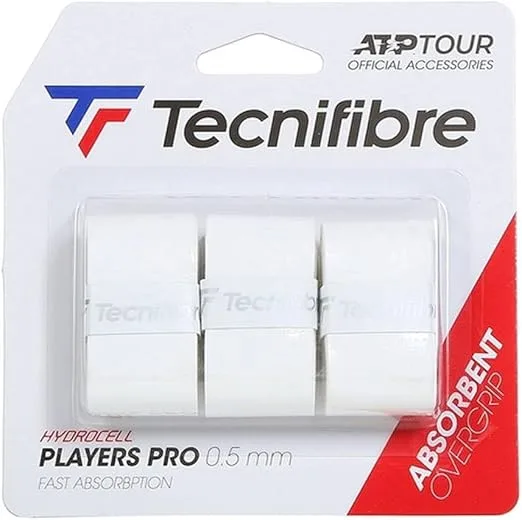
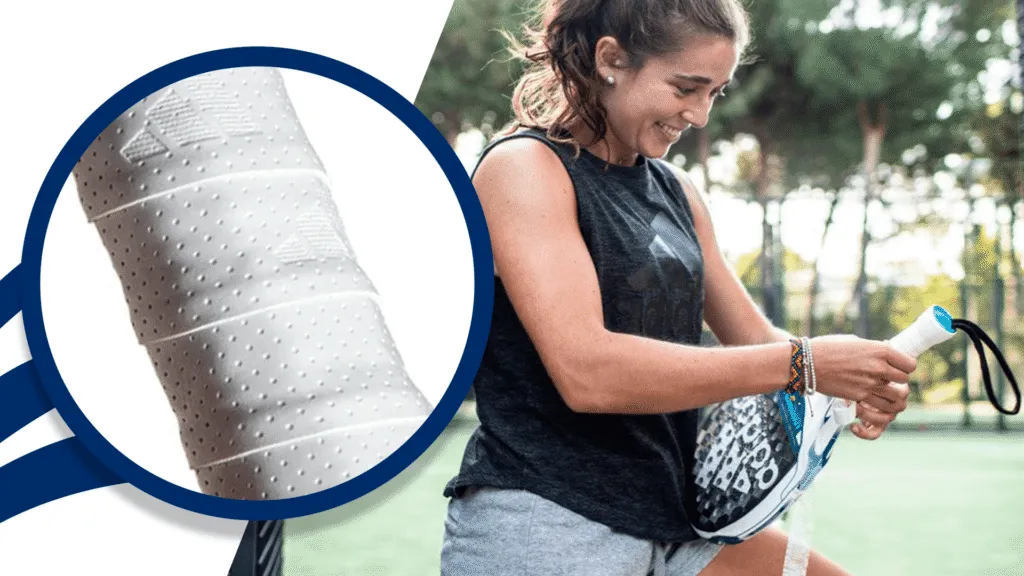
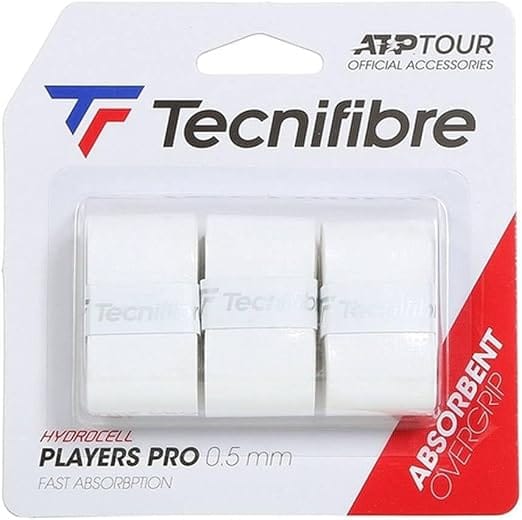
Overgrips are thin wrapping materials applied over the original factory grip of a padel racket handle. They are inexpensive, available at padel pro shops across Dubai and Abu Dhabi, and replace easily between sessions. Two main types are relevant to UAE conditions.
Tacky overgrips provide a sticky, connected feel. These work well in cooler or dry indoor conditions where moisture is not a significant factor.
Absorbent overgrips are designed to draw moisture away from the hand and maintain friction as sweat builds. These are generally more suitable for UAE players during warmer periods or longer sessions.
Many players change overgrips regularly rather than waiting until the grip is visibly worn. A fresh overgrip takes only a few minutes to apply and noticeably restores grip feel. For guidance on specific products, the Best Padel Overgrips UAE guide covers the main options available through UAE padel shops and Amazon.ae.

Grip and Injury Prevention
Holding the racket incorrectly over time can contribute to overuse discomfort in the wrist, forearm, and elbow. The most common presentation is lateral epicondyle irritation – soreness on the outer elbow – associated with repetitive wrist and forearm strain.
The main grip-related causes are holding too tightly throughout play, using a grip size that does not suit the hand, and using grip positions that place unnecessary rotational strain on the forearm during contact. The continental grip, held with appropriate relaxed tension and the correct size handle, is associated with more natural forearm alignment during padel shots compared to heavy forehand-dominant grips.
Players experiencing persistent wrist or elbow discomfort should seek advice from a qualified coach before continuing – both to check grip technique and to rule out other contributing factors. A sports physiotherapist or doctor should be consulted if discomfort is significant or ongoing.
For more information on prevention of injury, please read the article 7 Proven Ways to Avoid Padel Injury Prevention Failures in UAE Heat.
Quick Reference: Continental Grip Checklist
| Checkpoint | What to Look For |
|---|---|
| Safety strap | Secured around wrist before play |
| V position | Between thumb and index finger, on the top bevel (bevel 2) |
| Index knuckle | Base knuckle resting on bevel 2 |
| Heel pad | Fleshy base of palm contacting top bevel area |
| Thumb | Resting flat along the back or side of handle |
| Fingers | Wrapped naturally, not clenched or splayed |
| Hand position | Heel of hand flush with base of grip |
| Palm gap | Approx. one finger’s width between fingertips and base of thumb |
| Grip pressure | Moderate and relaxed during play, briefly firmer at ball contact |
| Overgrip condition | Fresh and dry; replace regularly in UAE heat |