
Padel Tournament Builder Quick Guide
The free padel tournament builder is designed to help organisers create a simple match schedule without needing a separate spreadsheet or account.
You can:
- Enter custom team names
- Choose between 1 and 5 courts
- Set match duration and start time
- Randomise the draw
- Generate knockout rounds automatically
- Assign byes where needed
- Include semi-finals, a final and a third-place match where applicable
- Copy the finished schedule for sharing
The current tool supports 2 to 32 teams and 1 to 5 courts.
It is most useful for:
- Club tournaments
- Social padel events
- Beginner competitions
- Coaching sessions
- Small corporate or community events
Once the schedule is generated, the next step is making sure the event runs smoothly on the day.
For background on how padel matches and scoring work, the padel rules and scoring guide covers sets, tiebreaks, and game format in plain language.
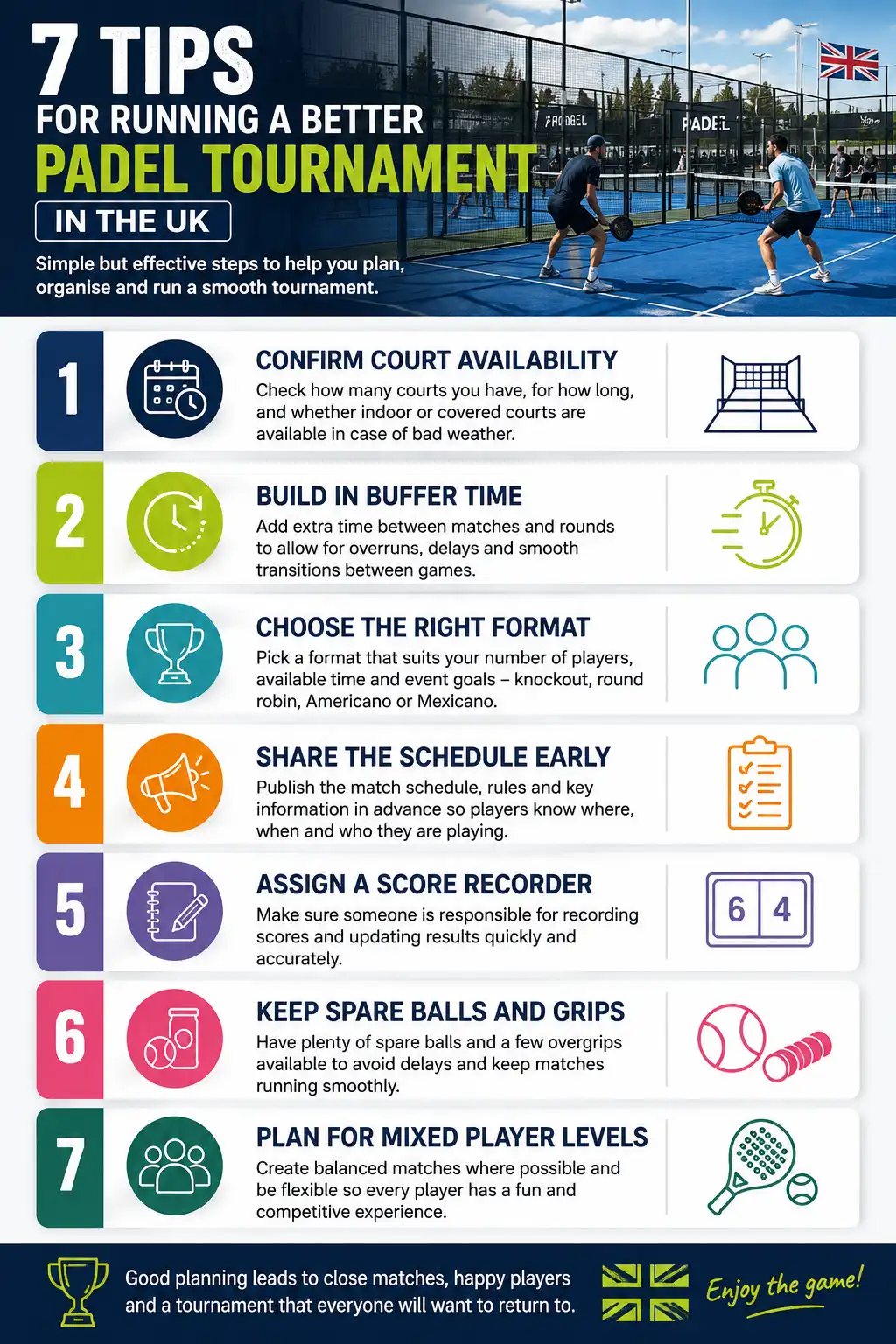
7 Tips for Running a Better Padel Tournament
A good padel tournament needs more than a bracket. Court availability, match timing, communication and equipment can all affect how smoothly the day runs.
1. Confirm the Courts Before Publishing the Schedule
Check how many courts are definitely available and whether any are shared with other bookings. The tournament schedule should be based on confirmed court access rather than assumed availability.
If fewer courts are available than expected, the whole event can quickly fall behind.
2. Build Buffer Time Between Matches
Avoid scheduling every match back-to-back with no margin.
A short buffer allows time for:
- Delayed finishes
- Players moving between courts
- Score confirmation
- Hydration breaks
- Court changes
Even a small amount of extra time can make the schedule easier to manage.
3. Match the Format to the Number of Players and Courts
A knockout format is simple and quick, but some players may only get one match.
Round-robin, Americano or Mexicano formats can give participants more court time, but they usually require more scheduling and court capacity.
Choose the format based on:
- number of teams
- number of courts
- available event time
- whether the event is competitive or social
We will cover the main formats in more detail later in the article.
4. Share the Schedule Before the Event
Once the draw and timetable are confirmed, send them to players in advance where possible.
This helps participants know:
- their first match time
- which court they are using
- who they are playing
- when they need to arrive
A simple copied schedule, PDF or shared message can reduce confusion on the day.
5. Assign One Person to Record Results
For small events, one organiser should be responsible for confirming scores and updating the next round.
This avoids situations where different players report different results or no one knows which team should advance.
For larger events, each court or group can have a designated score reporter.
6. Keep Spare Balls and Basic Equipment Available
Tournament play can be disrupted by worn balls, damaged grips or forgotten equipment.
Useful backup items may include:
- spare padel balls
- overgrips
- water
- towels
- basic first-aid supplies
Players should normally bring their own racket and footwear, but a small reserve of consumable items can help keep matches moving.
7. Plan for Different Player Levels
If the tournament includes players with mixed experience, consider how the format will affect enjoyment and competitiveness.
Possible approaches include:
- separate beginner and advanced groups
- seeded teams
- social round-robin formats
- consolation matches for early losers
The best approach depends on whether the aim is competition, participation or a mixture of both.
Padel Tournament Rules: What Organisers Should Decide Before Play
The exact rules can vary depending on the type of event, so organisers should confirm the format before the first match starts.
For a small UK club or social tournament, the main points to decide are:
- match format
- scoring system
- whether matches use full sets or shortened scoring
- how ties are handled
- whether there is a third-place match
- how late arrivals or withdrawals are treated
- whether players can be substituted
- how results are reported
The underlying rules of padel still apply, including serving, scoring, court boundaries and use of the walls.
For a full explanation of the sport itself, link naturally to your Padel Rules UK 2026 guide.
Keep the Rules Simple
For social tournaments, simple rules are usually easier to manage than complicated competition structures.
Before the event, send players a short rules summary that explains:
- when they need to arrive
- how long each match lasts
- what scoring system is being used
- what happens if the score is tied when time expires
- who reports the final score
That can prevent disagreements and delays during the tournament.
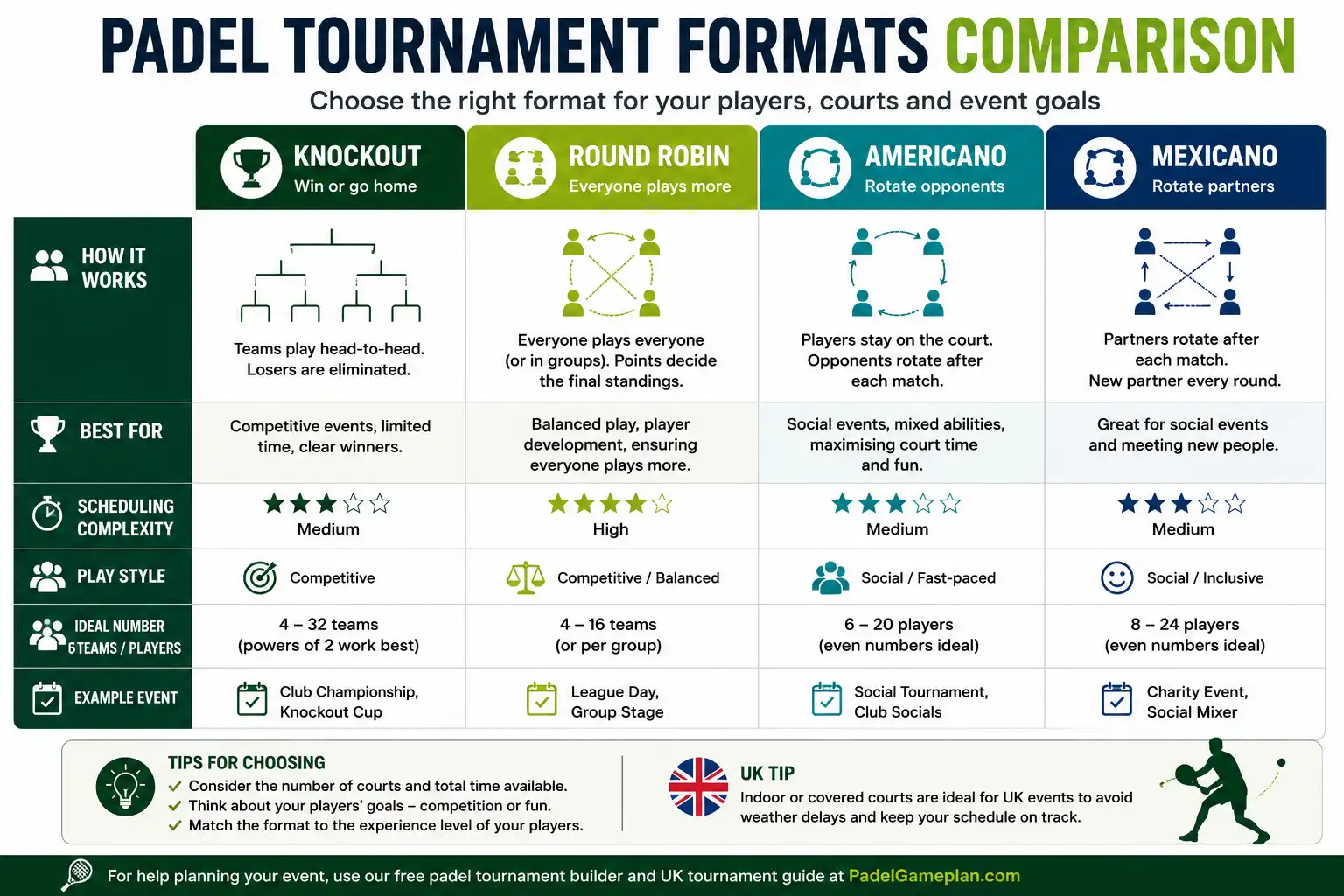
Common Padel Tournament Formats
There is no single padel tournament format that suits every event. The best option depends on the number of players, available courts and how much playing time you want each participant to receive.
Knockout
In a knockout tournament, the winning team progresses and the losing team is eliminated.
Best for:
Competitive events where time or court availability is limited.
Advantages:
Simple to understand and relatively easy to schedule.
Limitation:
Some teams may only play one match.
Your free builder is especially relevant here because the existing tool generates knockout rounds and automatically handles byes where required.
Round Robin
In a round-robin tournament, each team plays several opponents within a group.
Best for:
Social events or tournaments where organisers want players to receive more court time.
Advantages:
More matches and less chance of a team travelling to the event for only one game.
Limitation:
Requires more court time than a straightforward knockout.
Americano
A padel Americano tournament is commonly used for social play. Players rotate partners and opponents, with individual points accumulated across several short rounds.
Best for:
Social events and groups where players do not need to remain in fixed teams.
Advantages:
Players mix with more participants during the event.
Limitation:
The scheduling method is different from a conventional fixed-team knockout bracket.
Mexicano
Mexicano is another rotating social format. Matchups can change during the event according to results or rankings, helping players face opponents closer to their current performance level.
Best for:
Social groups wanting competitive but changing matchups.
Advantages:
Later matches can become more evenly matched.
Limitation:
It usually requires more active result tracking than a basic knockout event.
Which Format Should You Choose?
A simple guide:
| Tournament Goal | Suitable Format |
|---|---|
| Fast, competitive event | Knockout |
| Everyone gets several matches | Round robin |
| Social mixing and changing partners | Americano |
| Changing opponents based on results | Mexicano |
| Larger event with progression | Groups followed by knockout |
Padel Tournament Schedule Planning
A good padel tournament schedule should be realistic enough to keep matches moving without making players feel rushed.
Before generating the schedule, organisers should confirm:
- how many courts are available
- how long each match will last
- whether warm-up time is included
- how much buffer time is needed between rounds
- whether the final needs a separate time slot
- whether all courts are available for the full event
The free builder can then be used to organise the knockout sequence around those inputs.
Allow for Match Overruns
Not every match will finish exactly on time.
A small buffer between rounds can help with:
- close matches running long
- players changing courts
- score reporting
- short hydration breaks
- resolving scheduling delays
For a social or club event, it is usually better to build in some flexibility rather than schedule every court continuously with no margin.
Avoid Long Gaps Between Matches
While some buffer time is useful, large gaps can make the event feel slow.
Try to balance:
- enough recovery time
- sensible court rotation
- minimal unnecessary waiting
- a clear progression toward the semi-finals and final
Check the Schedule Before Sharing It
Before sending the schedule to players, review it for obvious problems.
Check that:
- no team is scheduled on two courts at the same time
- court numbers are clear
- match times are realistic
- byes are shown correctly
- later rounds have enough time allocated
- the final and third-place match do not create conflicts
The current builder already handles knockout progression and byes, but the organiser should still review the finished schedule before using it for the event.
Share the Schedule in a Simple Format
Once everything is confirmed, send players a simple version of the schedule that is easy to read on a phone.
This can include:
- team names
- first match time
- court number
- expected round times
- organiser contact details
The existing tool also supports copying the schedule for sharing, which is useful for WhatsApp, email or club messages.
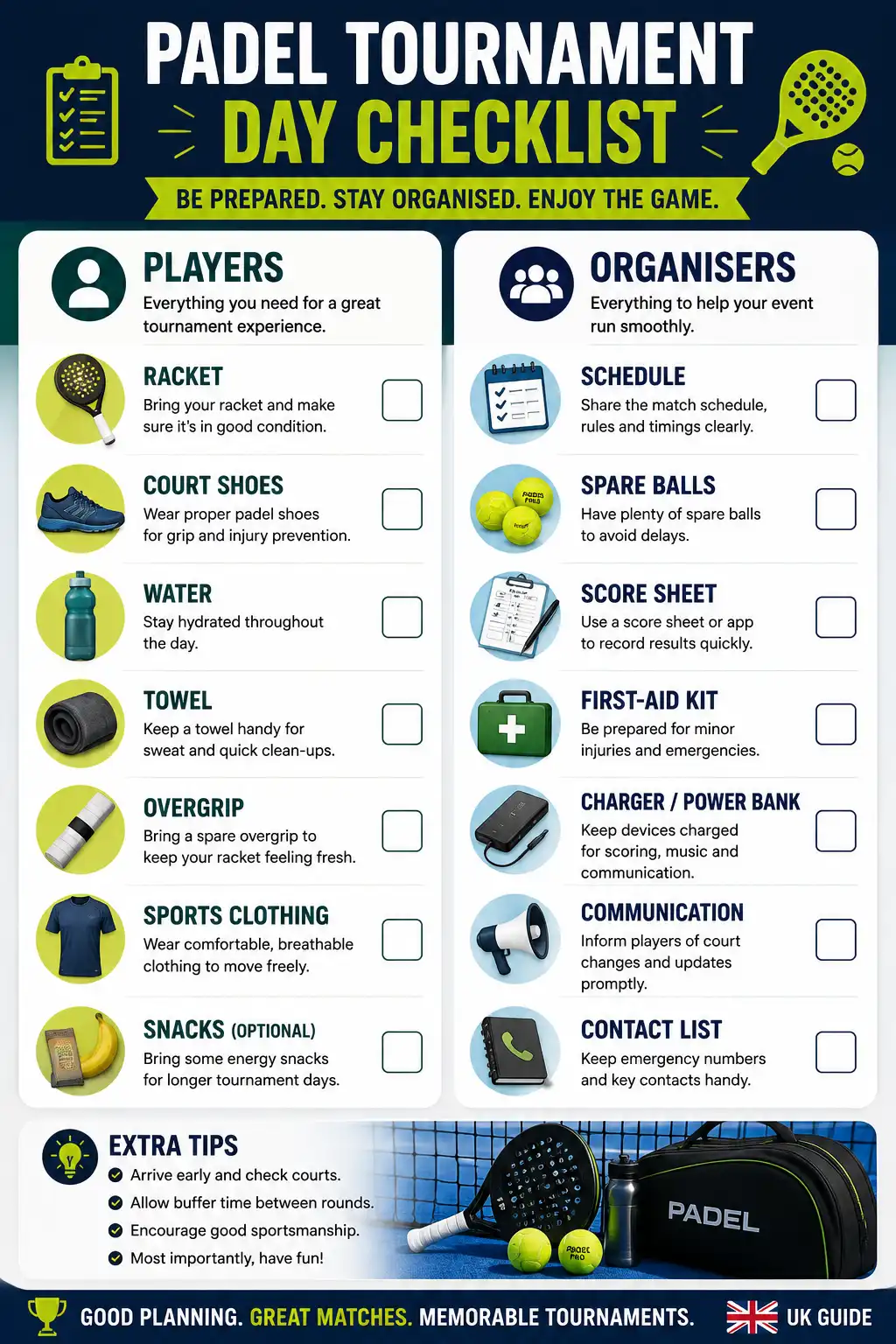
Padel Tournament Day Checklist
A simple checklist can help prevent delays once players start arriving. The exact setup depends on the size of the event, but most organisers should confirm the following before the first match.
For Organisers
- final match schedule
- court numbers
- team or player list
- spare padel balls
- score-recording method
- contact details for participants
- basic first-aid supplies
- water access
- spare overgrips where practical
- phone charger or power bank
- clear instructions for reporting results
If the venue provides balls, racket hire or other equipment, confirm this in advance rather than assuming it will be available.
For Players
Players should normally bring:
- padel racket
- suitable court shoes
- water bottle
- towel
- spare overgrip
- comfortable sports clothing
- any personal accessories they normally use
A dedicated padel bag is optional, but it can make it easier to carry shoes, clothing, balls and small accessories during a longer tournament day.
Before the First Match
Organisers should also check that:
- all courts are ready
- players know where to report
- the scoring format has been explained
- the first-round schedule is visible or shared
- spare balls are available
- results can be recorded quickly
- players understand what happens if a match runs late
What Equipment Do You Need for a Padel Tournament?
Some product mentions may include affiliate links.
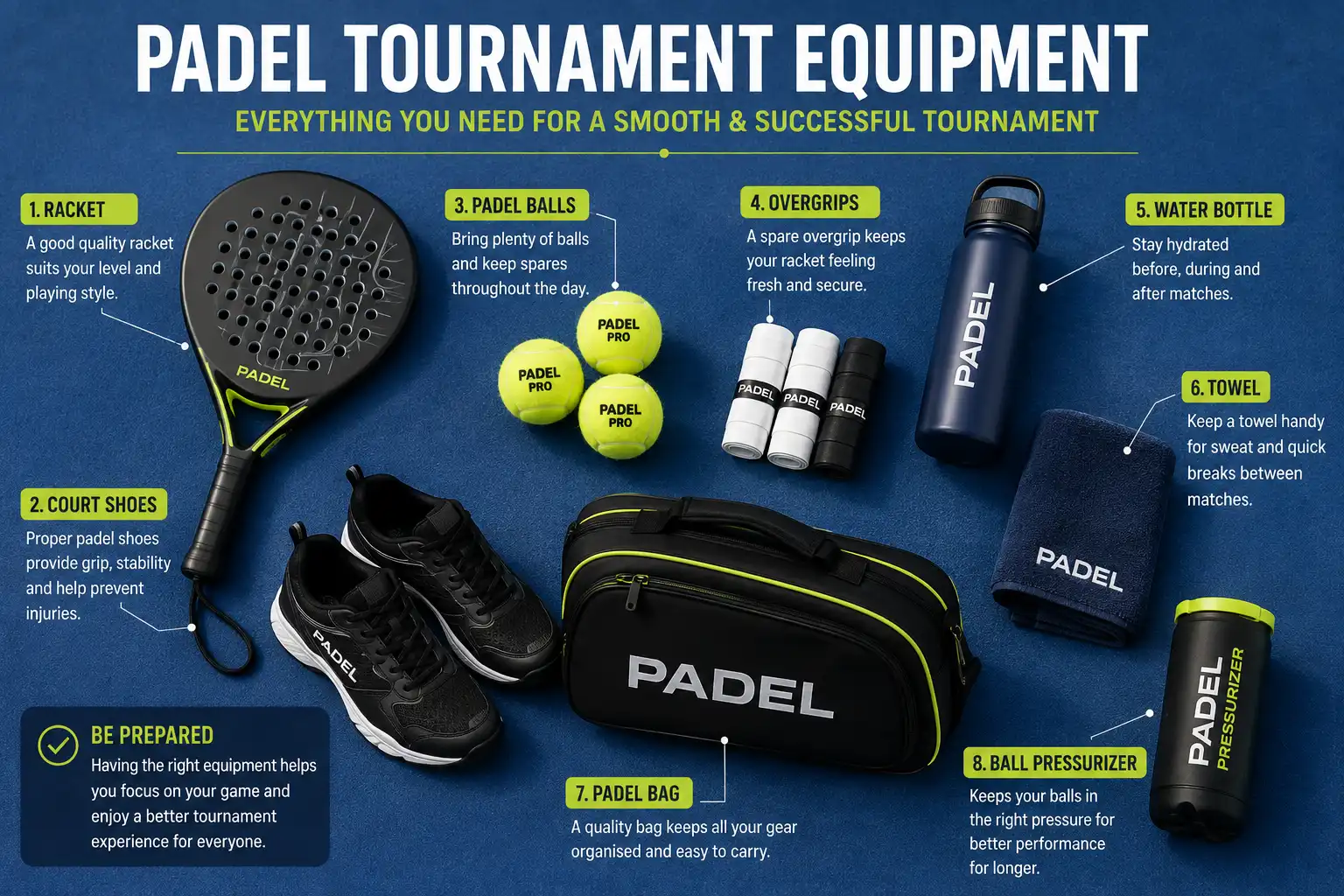
A padel tournament does not require a large amount of specialist equipment, but both players and organisers should make sure the essentials are covered before play starts.
For most UK events, the main priorities are suitable rackets, court footwear, padel balls and enough spare consumables to deal with small problems during the day.
Tournament Equipment at a Glance
| Item | Who Needs It? | Priority | Why |
|---|---|---|---|
| Padel racket | Player | Essential | Needed to play |
| Court shoes | Player | Essential | Better suited to lateral movement and quick direction changes |
| Padel balls | Organiser / players | Essential | Needed for matches and useful as spares |
| Overgrips | Player | Useful | Easy to replace if a grip becomes worn or slippery |
| Water bottle | Player | Recommended | Useful during repeated matches |
| Towel | Player | Recommended | Helpful between games |
| Padel bag | Player | Optional | Useful for carrying racket, shoes and accessories |
| Ball pressurizer | Organiser / regular player | Optional | Useful for storing opened balls between sessions |
Padel Rackets
Players will normally bring their own racket, although some venues may offer racket hire for beginners or social events.
Court Shoes
Padel involves repeated lateral movement, short sprints, stopping and changes of direction.
Suitable court footwear is therefore more appropriate than ordinary running shoes for regular play.
Padel Balls
Organisers should make sure enough balls are available for all planned matches, with some spares in case balls are lost or become unsuitable for play.
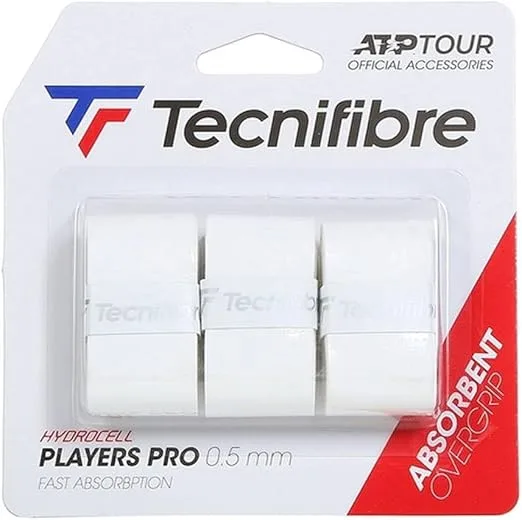
Overgrips
Overgrips are one of the most useful low-cost accessories for tournament players because they are quick to replace during a long session.
A fresh overgrip can improve comfort if the existing grip becomes worn or slippery.
Padel Bags
A padel bag is optional, especially for beginners, but it becomes more useful during tournament days when players may carry:
- Racket
- Shoes
- Spare clothing
- Towel
- Balls
- Grips
- Water
Ball Pressurizers
A ball pressurizer is not required to run a tournament, but frequent players or organisers may use one to store opened balls between sessions.
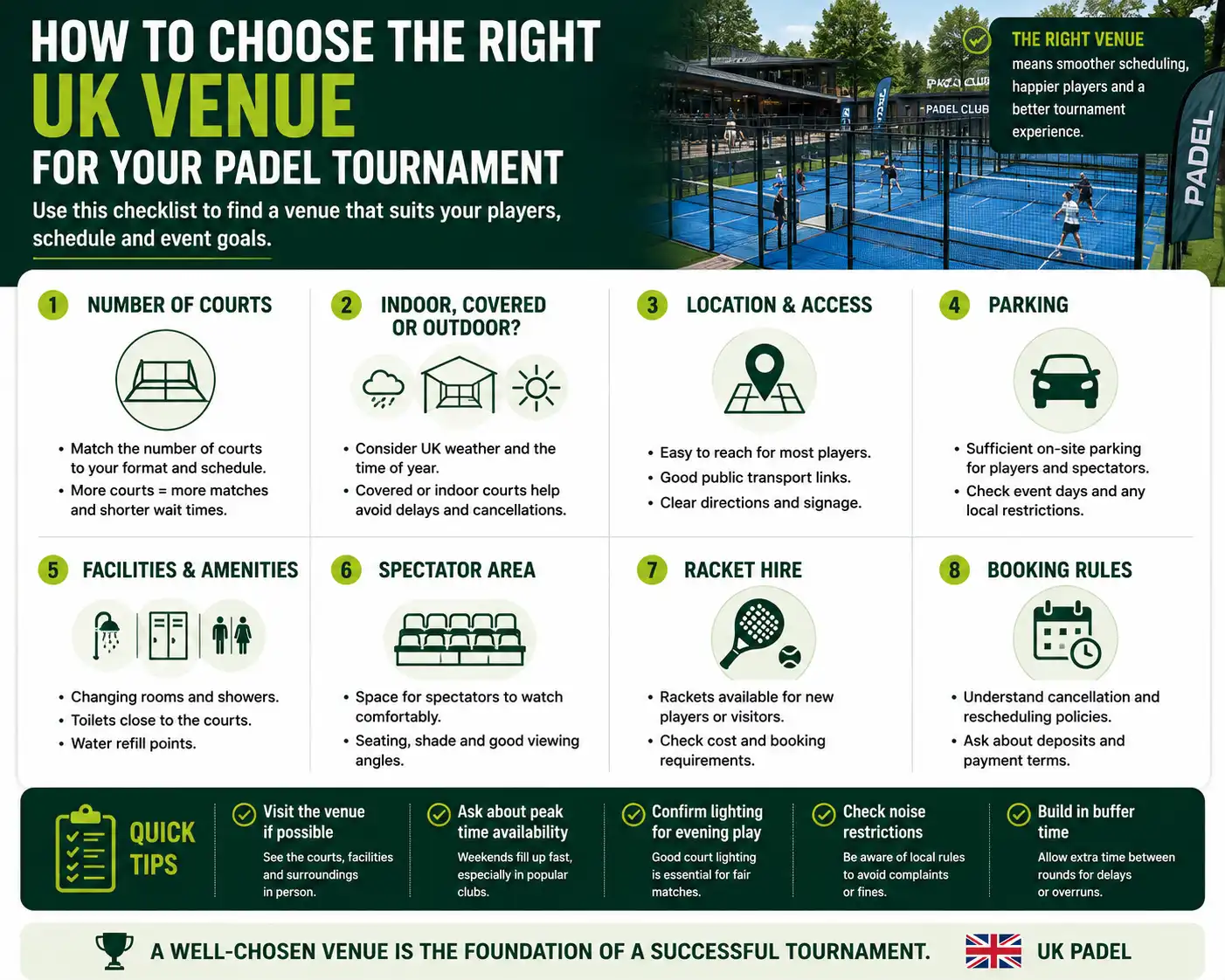
How to Choose a UK Venue for a Padel Tournament
The right venue can make a big difference to how smoothly a padel tournament runs. Before confirming a booking, organisers should check more than just the number of courts.
Court Availability
Confirm how many courts are available for the full event period.
For a larger tournament, using several courts at the same time can reduce waiting and help keep the schedule on track.
Indoor, Covered or Outdoor Courts
UK weather can affect tournament planning, especially for outdoor venues.
Indoor or covered courts may reduce the risk of delays, while outdoor courts can still work well if the event has a backup plan for poor weather.
Racket Hire and Equipment
If beginners or occasional players are taking part, check whether the venue offers:
- Racket hire
- Balls
- Coaching support
- Changing facilities
- Water access
This can make the event easier for players who do not yet own all their equipment.
Parking and Public Transport
For social or larger events, accessibility matters.
Check:
- Parking availability
- Nearby public transport
- Venue opening hours
- Arrival time requirements
Spectator and Waiting Areas
Some tournaments involve periods of waiting between matches.
A venue with seating, café facilities or a comfortable waiting area can improve the experience for both players and spectators.
Booking Rules and Court Costs
Before finalising the tournament, confirm:
- Court hire rates
- Peak and off-peak pricing
- Cancellation terms
- Minimum booking periods
- Whether tournament or event bookings need special approval
Prices and policies can change, so these should always be verified directly with the venue.
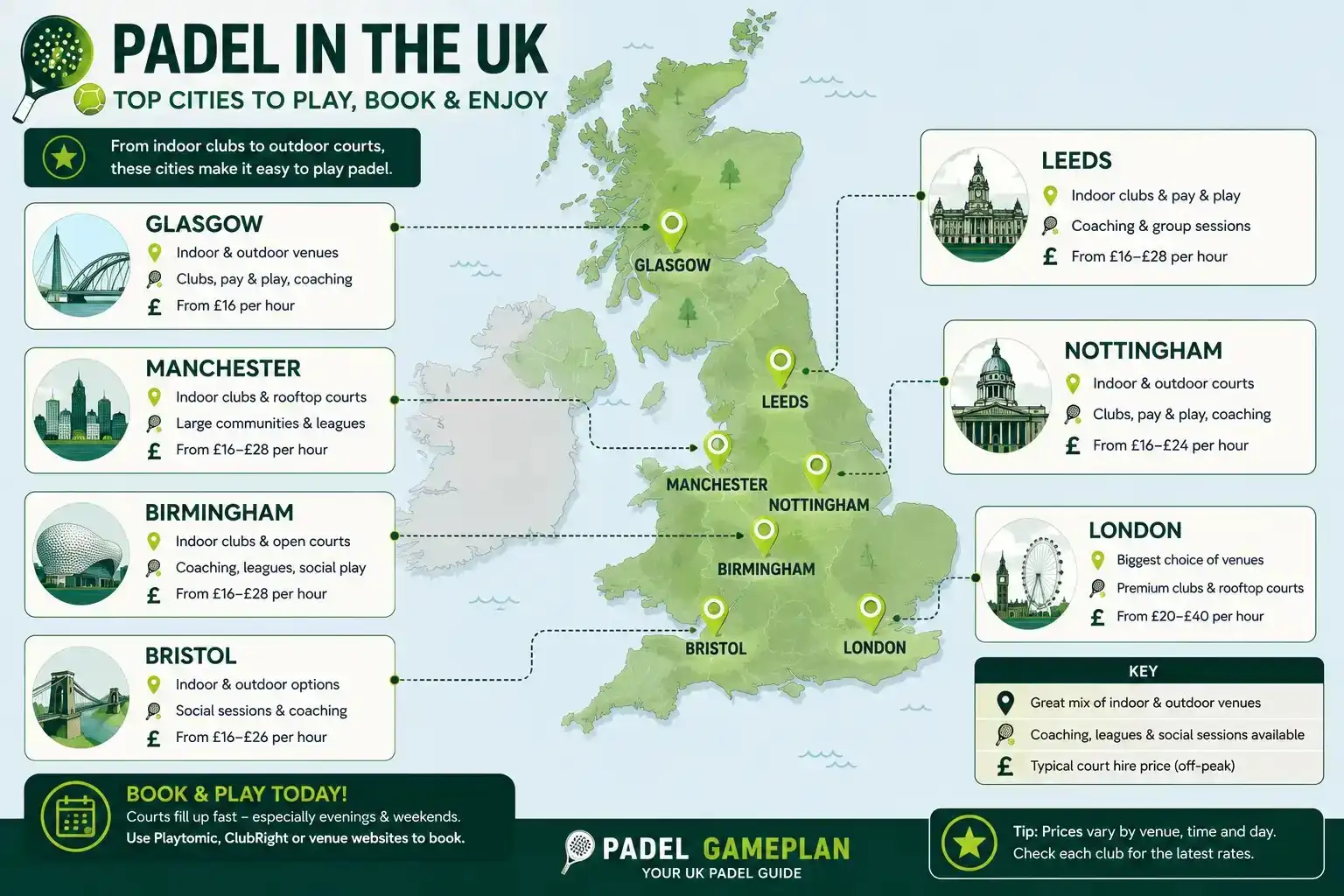
UK Padel City Guides
Use the local guides below to compare courts, prices, coaching and booking options:
- Padel London 2026 – compare major clubs, court options and prices across London.
- Padel Manchester 2026 – find indoor, covered and outdoor venues across Greater Manchester.
- Padel Birmingham 2026 – compare clubs, court hire and beginner-friendly options.
- Padel Glasgow 2026 – see current venues, prices and coaching options in Glasgow.
- Padel Leeds 2026 – compare indoor courts, clubs and upcoming venues in Leeds.
- Padel Nottingham 2026 – find local padel courts and booking options.
- Padel Bristol 2026 – compare the main clubs, indoor courts and prices in Bristol.