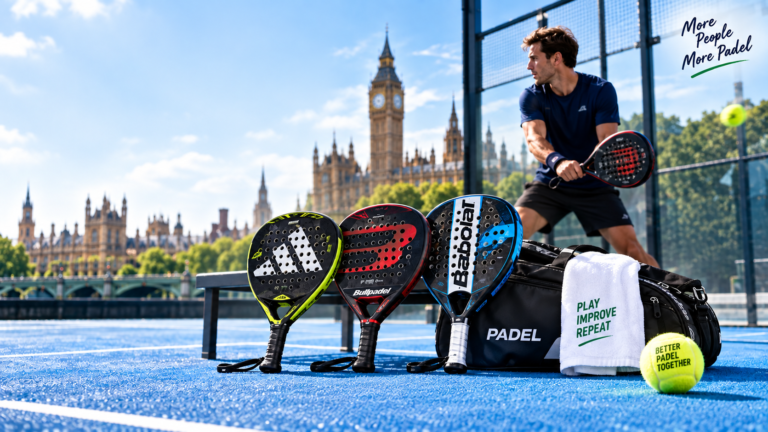
UK PADEL RACKET GUIDE 2026
The Ultimate Padel Racket Guide for UK Players: 10 Powerful Tips (2026)
Choosing the right racket can be difficult when there are so many shapes, materials and specifications available.
This Padel Racket Guide UK for 2026 explains racket shape, weight, balance, face material, core density, comfort, price and playing level, helping UK players choose a racket that suits their current game rather than buying on brand name or appearance alone.
The right racket is different for a new player learning basic control, an intermediate player developing wall play and tactics, and an advanced player looking for more precision or attacking power. This guide is designed to help narrow those choices before comparing individual models.Quick Answer: Which Padel Racket Should You Choose?
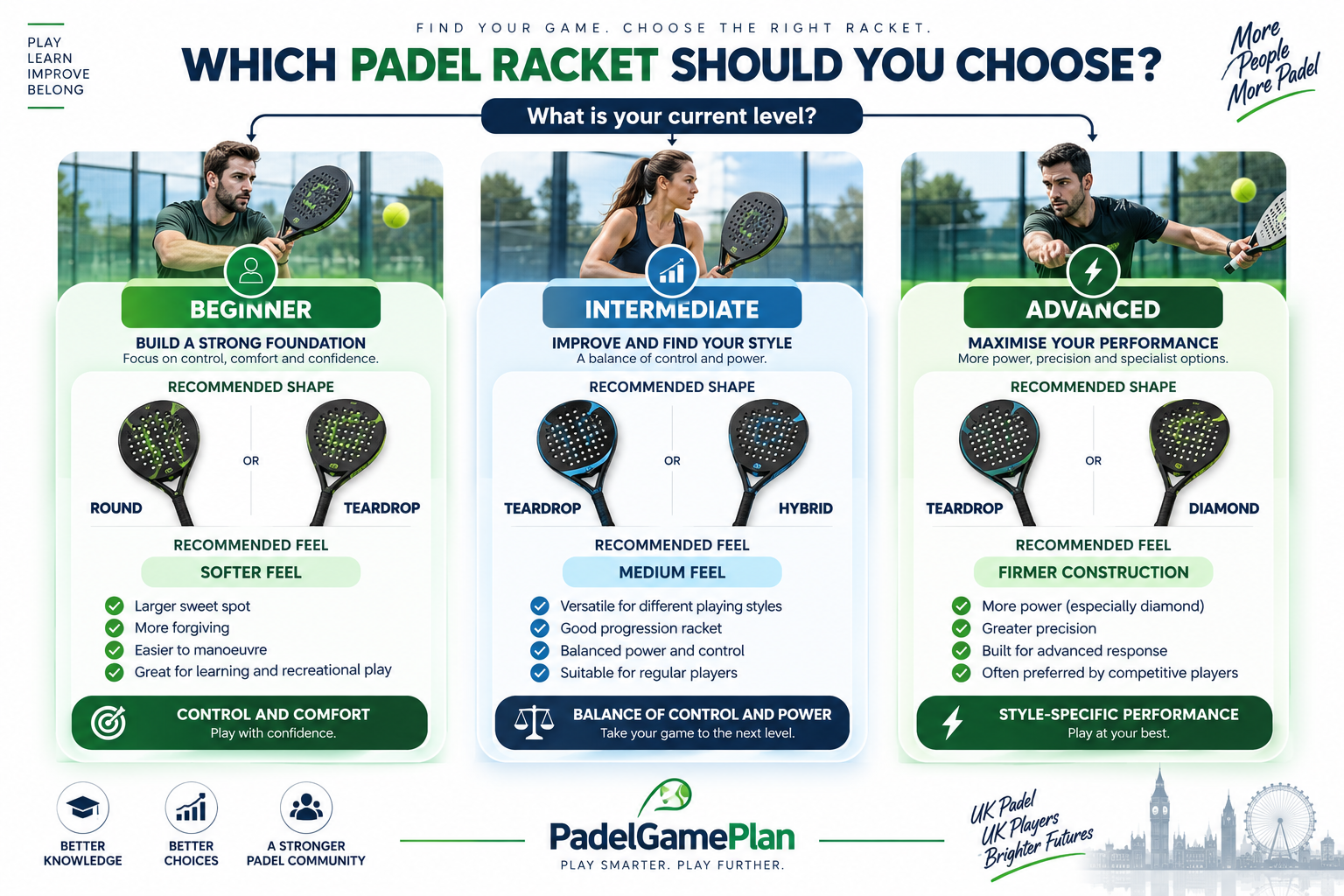
The 3 Padel Racket Guides on PadelGamePlan
This page is the main buying guide. The three level-specific guides go deeper into suitable racket categories for beginners, intermediate players and advanced players.| Your Level | What to Prioritise | Dedicated Guide |
|---|---|---|
| Beginner | Forgiveness, control, softer feel and manageable weight | Best Padel Racket for Beginners |
| Intermediate | Balanced power, control, spin and improved stability | Best Intermediate Padel Rackets |
| Advanced | Precise response, higher-performance materials and style-specific balance | Best Advanced Padel Rackets |
Padel Racket Comparison by Shape
Some product mentions may include affiliate links.Adidas Cross IT CTRL
A control option for players who prefer placement, stability and a manageable sweet spot.Check PriceBullpadel Teardrop
A teardrop-style option for players looking for a middle ground between control and attacking power.Check PriceBabolat Technical Viper
A more demanding attacking racket aimed at experienced players who generate clean contact consistently.Check Price1. Know What Makes a Padel Racket Different
A padel racket has no strings. It uses a solid perforated hitting face, an internal foam or EVA core and a rigid frame. That means much of the racket’s feel comes from the combination of face material, core density, shape, weight and balance.Padel rackets are also governed by equipment dimensions under the official rules. For normal purchasing, players do not need to measure every racket themselves, but buying from recognised padel retailers helps ensure the product is designed for the sport and suitable for organised play.2. Choose the Right Padel Racket Shape
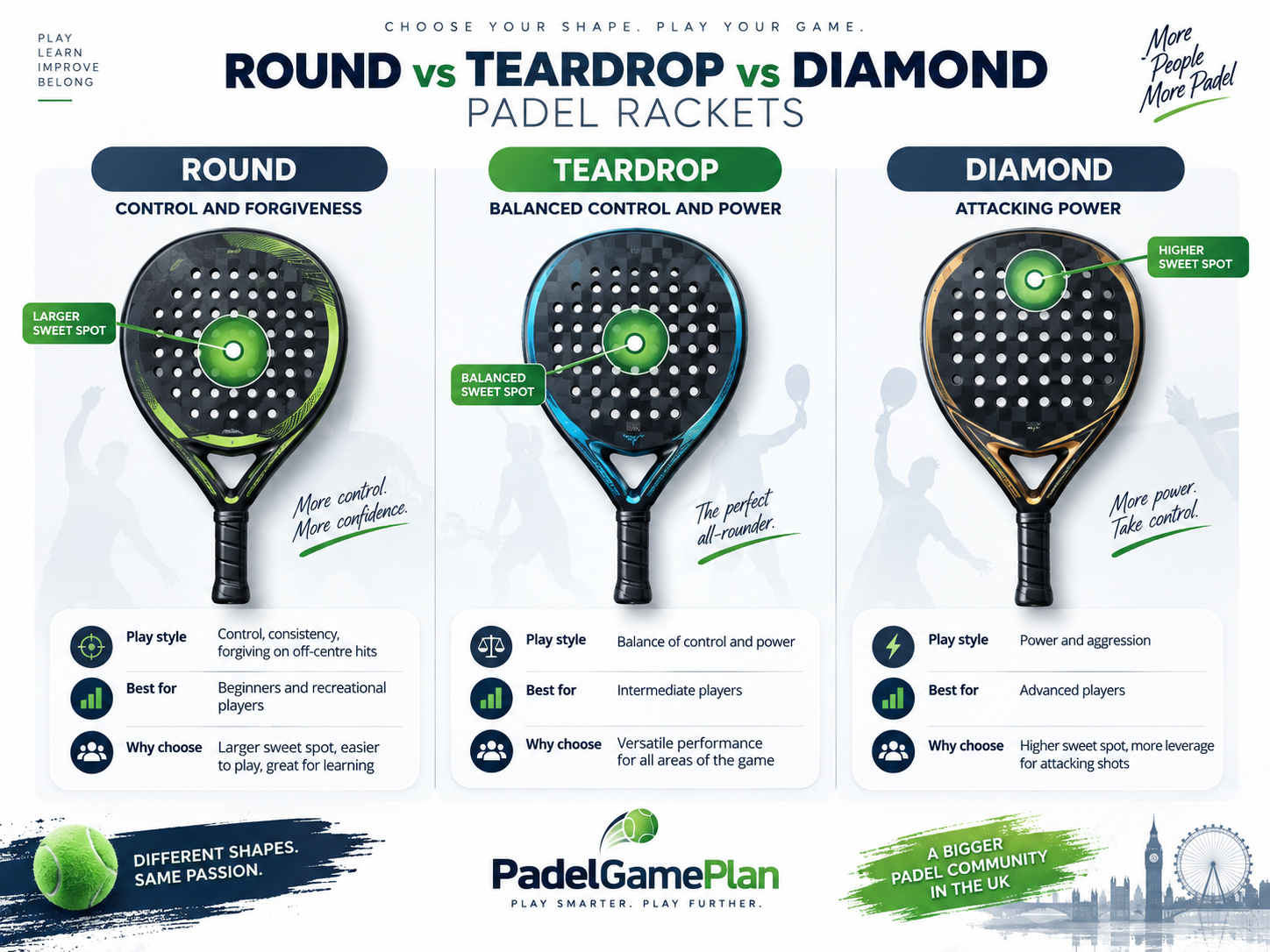
Shape is one of the most important decisions because it influences sweet-spot position, balance and forgiveness. The following Padel Racket Guide UK comparison covers the three common categories: round, teardrop and diamond.| Shape | Typical Sweet Spot | Common Strength | Often Suits |
|---|---|---|---|
| Round | Central | Control and forgiveness | Beginners and control-focused players |
| Teardrop | Slightly higher | Balanced control and power | Intermediate and all-round players |
| Diamond | Higher on the face | Attacking power | Experienced, aggressive players |
3. Match the Face Material to Your Level
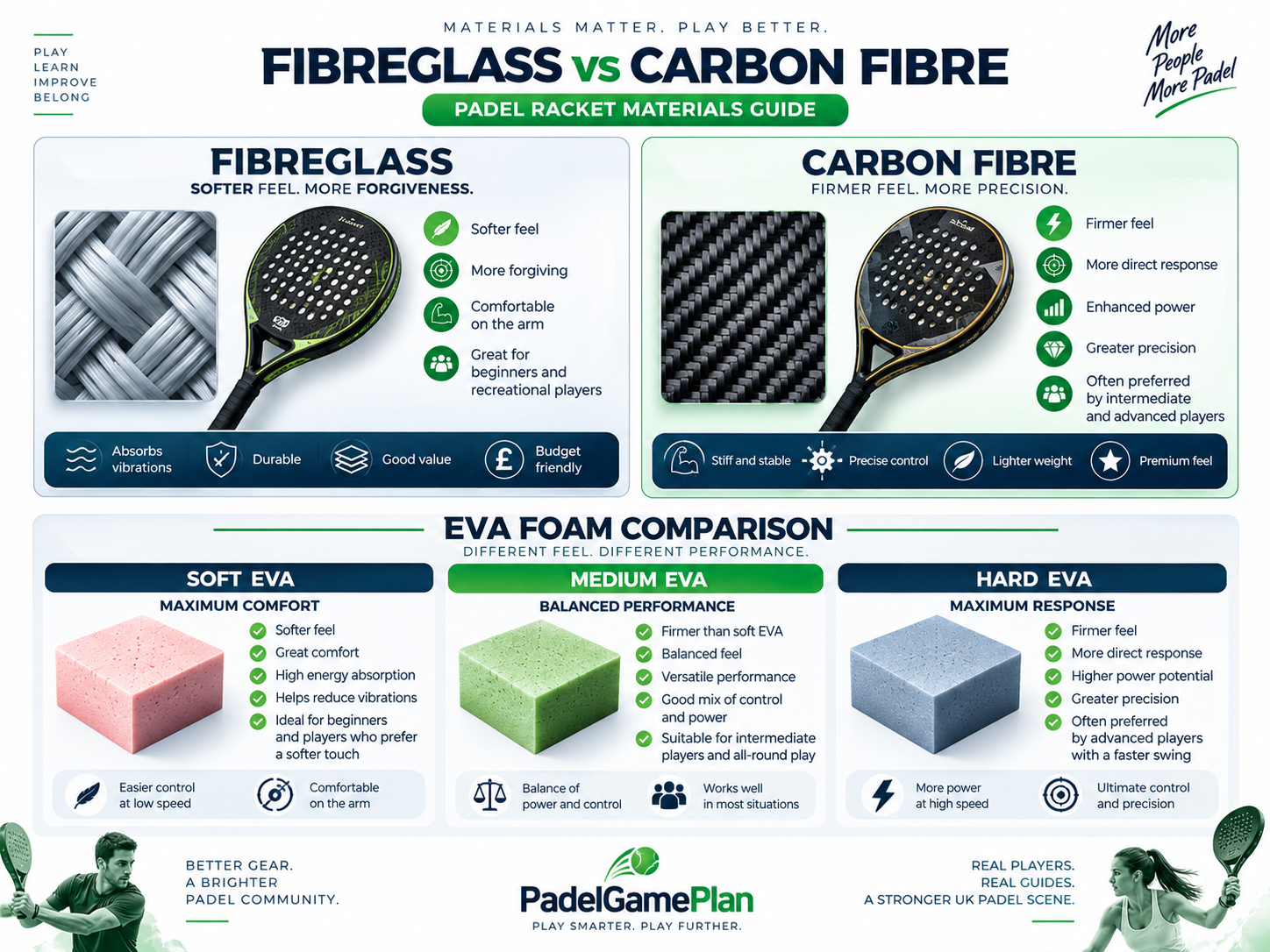
Fibreglass and carbon fibre are common racket-face materials. The exact feel depends on the full construction, but fibreglass is generally associated with a softer, more elastic response, while carbon constructions can feel firmer and more direct.| Face Material | Typical Feel | Forgiveness | Common Use |
|---|---|---|---|
| Fibreglass | Softer and more elastic | High | Beginner to early intermediate |
| Lower-count carbon constructions | Balanced to firm | Medium | Intermediate |
| Stiffer carbon constructions | Crisp and direct | Lower | Advanced players seeking precision |
4. Choose the Right Core Feel
The internal core strongly influences comfort, rebound and how direct the racket feels at impact. Brands use different names for their foams and EVA compounds, so compare the stated feel rather than assuming every “soft EVA” or “hard EVA” behaves identically.| Core Type | Typical Feel | Comfort | Often Suits |
|---|---|---|---|
| Soft foam / soft EVA | Cushioned | Higher | Beginners and comfort-focused players |
| Medium EVA | Balanced | Medium to high | Intermediate and all-round players |
| Hard / high-density EVA | Firm and direct | Lower | Advanced players with established technique |
5. Consider Weight and Balance Together
Static weight does not tell the whole story. Two rackets with similar listed weights can feel very different because the weight is distributed differently around the frame.Weight
Lighter rackets are generally easier to manoeuvre and can reduce fatigue during fast exchanges. Heavier rackets may provide more stability, but they demand more from the wrist, forearm and shoulder.Balance
Head-light rackets usually feel faster through the air. Higher-balance rackets can add leverage on overhead shots, but they can also feel more demanding during defence and quick net reactions.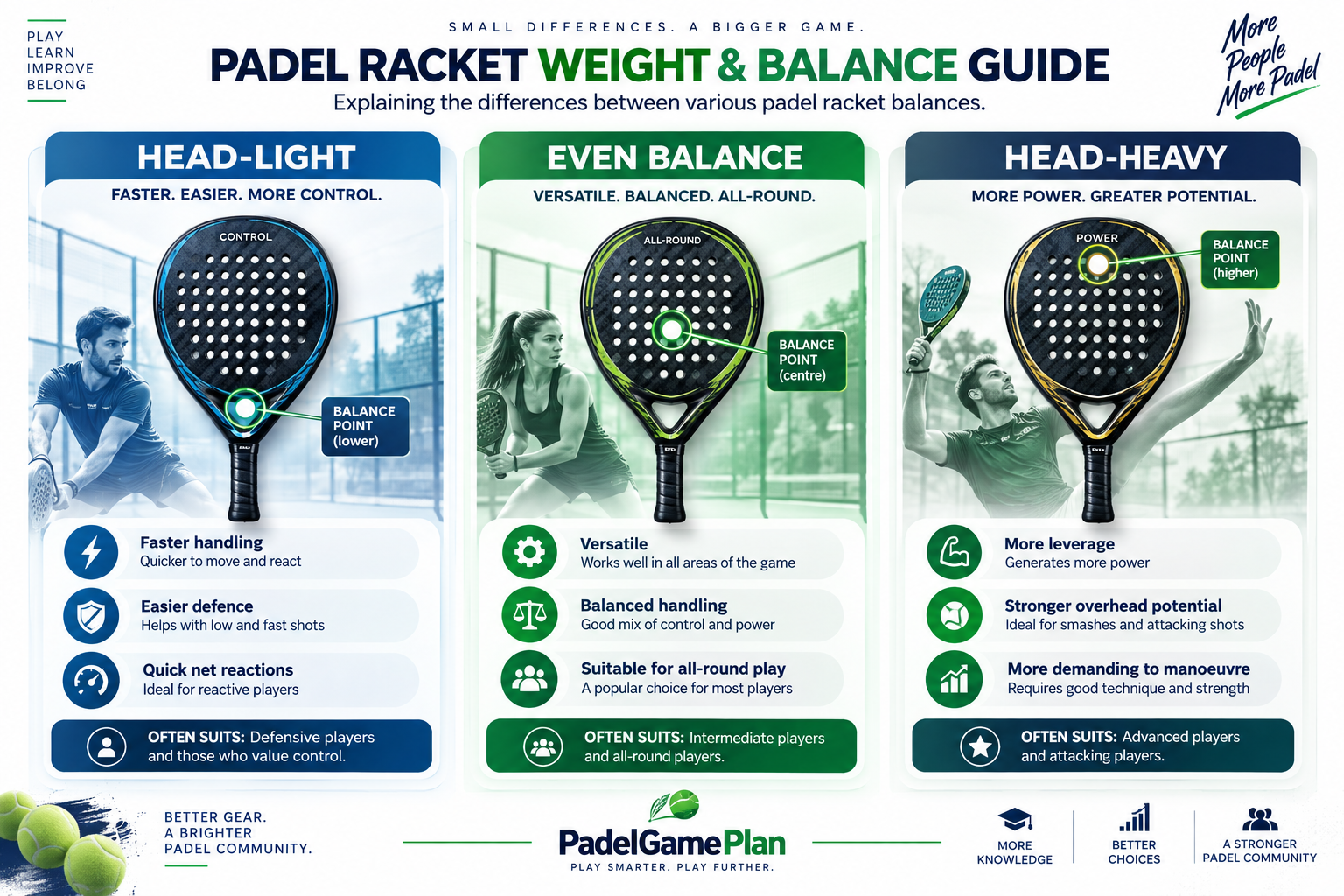
6. Set a Realistic UK Budget
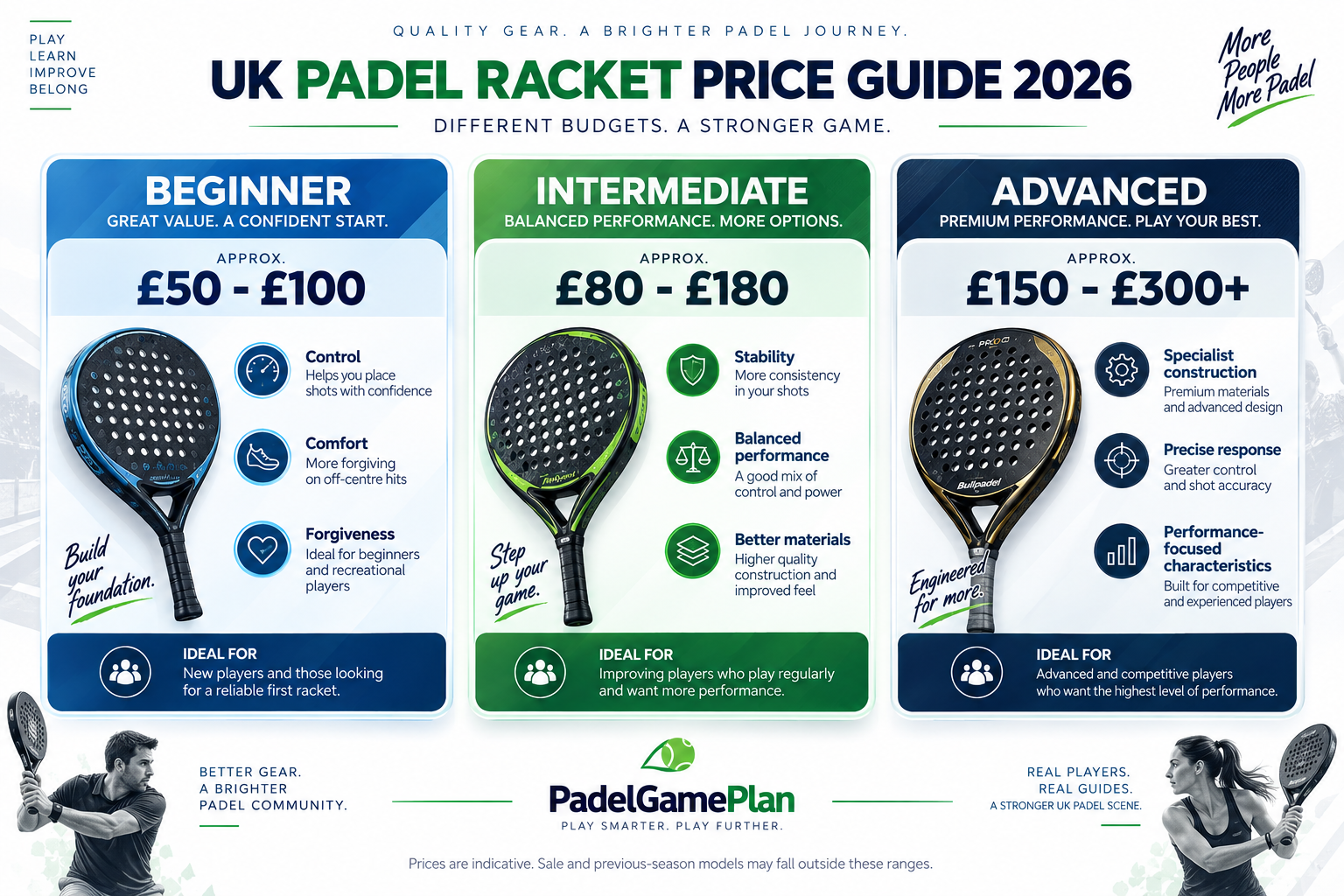
A useful Padel Racket Guide UK should consider playing level before price. Spending more does not automatically make a racket easier to use. In the UK market, entry-level adult rackets can often be found from around £50-£100, capable intermediate options commonly sit around £80-£180, and premium performance models frequently reach roughly £180-£300 or more. Sale pricing can create substantial overlap between those bands.| Player Stage | Indicative UK Budget | What Matters Most |
|---|---|---|
| Beginner | About £50-£100 | Control, comfort, forgiveness and easy handling |
| Intermediate | About £80-£180 | Better stability, balance and style-specific performance |
| Advanced | About £150-£300+ | Precise construction, response and specialist characteristics |
These are practical shopping bands rather than fixed rules. Clearance models from a previous season may cost far less than their original recommended retail price, while limited or professional-specification models may cost more.
7. Match the Racket to Your Playing Style
Defensive or placement-focused
Look for a forgiving sweet spot, manageable balance and predictable response when defending from the back of the court.Balanced game
A teardrop or hybrid shape can suit players who move between defence, transition play and attacking volleys.Power-focused
Experienced players may prefer higher balance, firmer response and a smaller sweet spot if their overhead technique is reliable.8. Prioritise Comfort and Arm Health
A racket should not be selected only for power. A combination of excessive weight, high balance, stiff construction and poor technique can make a racket tiring to swing. Players with recurring wrist, elbow or shoulder discomfort should consider a more manageable specification and seek appropriate professional medical or coaching advice where needed.Comfort checklist
- Can the racket be moved quickly at the net without feeling late?
- Can it be used for a full session without unusual forearm fatigue?
- Does off-centre contact feel excessively harsh?
- Is the grip size comfortable after adding the preferred overgrip?
- Does the racket still feel controllable when defending under pressure?
9. Consider UK Indoor and Outdoor Playing Conditions
UK padel is played on a mix of indoor, covered and outdoor courts. A racket does not need a separate “UK specification”, but temperature, moisture and ball condition can affect how a session feels.Colder conditions can make the ball feel slower and firmer than on a warm day, while wet outdoor conditions can affect grip and ball behaviour. Keep the racket dry, avoid leaving it for long periods in a cold or damp car boot, and use a protective cover or racket bag when travelling to outdoor courts.10. Test, Protect and Replace Your Racket Sensibly
Specifications are useful, but feel is personal. Where possible, try a club demo racket, borrow a similar model from another player, or buy from a retailer with clear product specifications and returns information.Protect the frame
Use a padded bag and avoid repeated contact with court fencing, glass surrounds or the floor.Replace when performance changes
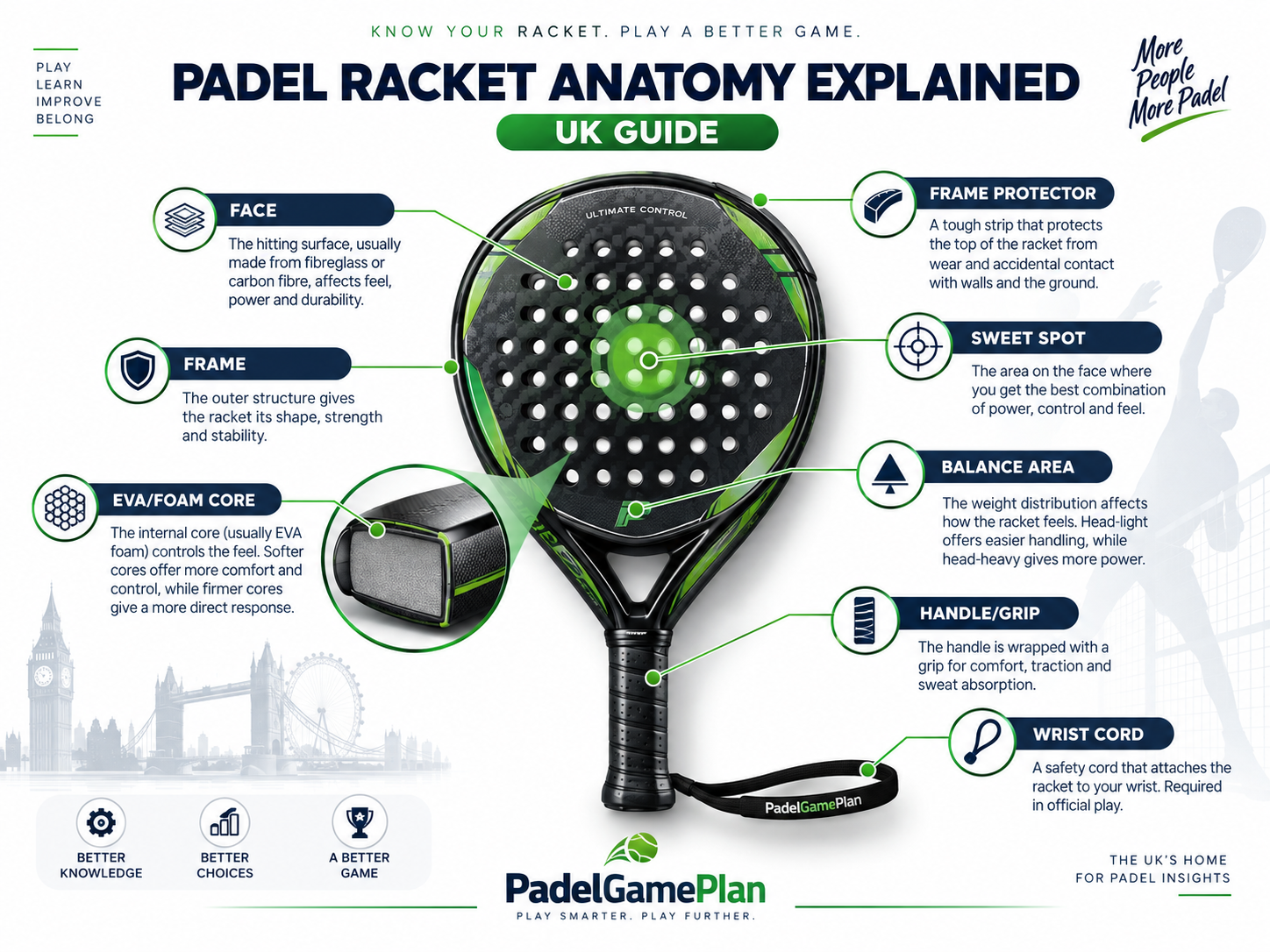
Consider replacement when cracks, structural damage, unusual vibration or a significant loss of response becomes apparent.Padel Racket Construction: Parts Explained
| Component | Function | What to Compare |
|---|---|---|
| Face | Primary ball-contact surface | Fibreglass, carbon construction and surface texture |
| Core | Influences rebound, comfort and firmness | Soft, medium or hard foam/EVA feel |
| Frame | Provides structural support | Material, stiffness and reinforcement |
| Sweet spot | Most forgiving contact zone | Size and position |
| Balance | Changes manoeuvrability and leverage | Head-light, even or head-heavy feel |
| Bumper / protector | Helps protect the racket edge | Integrated protection or replaceable strip |
| Handle and grip | Controls racket orientation and comfort | Grip shape, thickness and overgrip setup |
| Wrist cord | Safety retention during play | Secure fit and condition |
Padel Racket Brands Commonly Available in the UK
UK players can find rackets from major padel and racket-sport manufacturers through specialist retailers and large online stores. Availability changes throughout the season, particularly when new model-year ranges launch.Padel Racket Reviews
NOX ML10 Pro Cup Review
A control-oriented round racket family commonly associated with easy handling and a more forgiving feel.Read the reviewAdidas Metalbone HRD 2025 Review
A firmer, attacking racket designed for experienced players who prefer a direct response.Read the reviewHEAD Coello Pro 2025 Review
A power-focused model aimed at aggressive overhead and attacking play.Read the reviewNOX AT10 Genius 12K Review
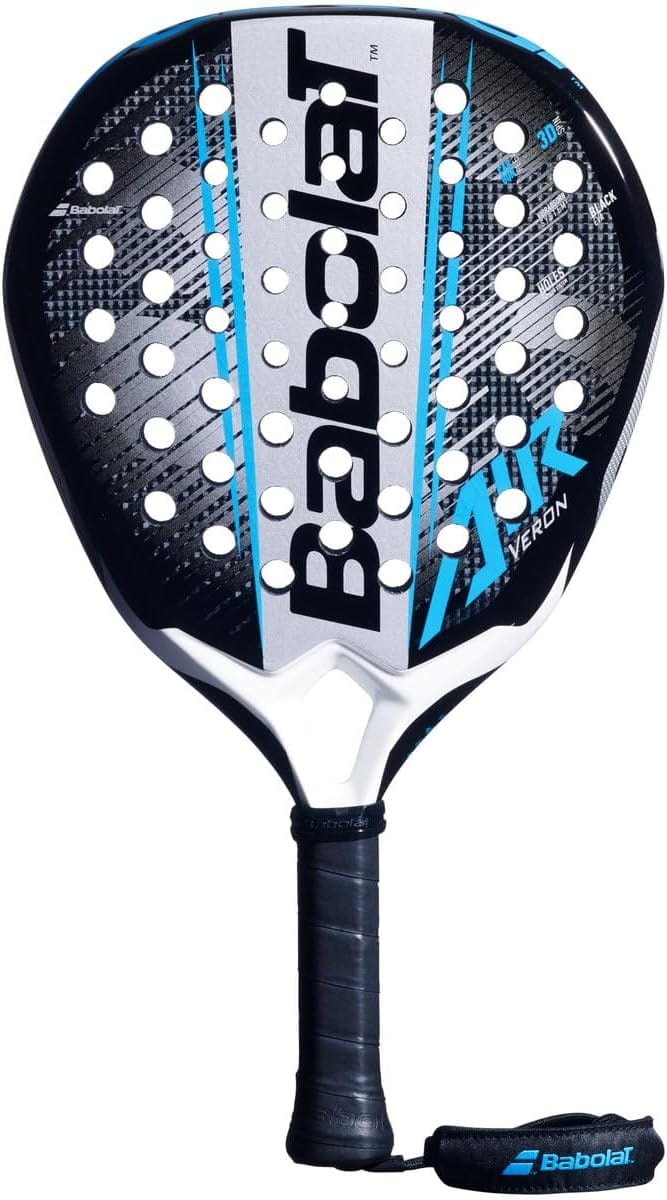
An all-round performance option combining manoeuvrability, control and useful attacking potential.Read the reviewBabolat Counter Veron 2025 Review
A racket aimed at counter-attacking and placement-focused players.Read the reviewNOX AT10 Genius 18K Review
A firmer advanced option for players who prefer precise, stable response.Read the reviewAdidas Metalbone 3.4 2025 Review
An attacking racket focused on spin, overhead play and offensive performance.Read the reviewBabolat Technical Viper 2025 Review
A stiff, power-oriented racket intended for experienced attacking players.Read the reviewCommon Mistakes When Choosing a Padel Racket
- Buying a demanding diamond racket too early.
- Choosing power before learning consistent control.
- Ignoring balance and focusing only on total weight.
- Buying entirely on brand, appearance or professional endorsement.
- Assuming a higher carbon number always means a better racket.
- Using a stiff, head-heavy racket despite recurring arm discomfort.
- Paying premium prices for performance characteristics that do not match current technique.
Related PadelGamePlan Guides
Frequently Asked Questions: Padel Racket Guide UK 2026
Use this Padel Racket Guide UK FAQ section as a quick reference when comparing racket shape, weight, materials, price and playing level.1. What is the best padel racket shape for beginners?
Round rackets are commonly recommended for beginners because the sweet spot is usually more central and forgiving. A forgiving teardrop racket can also work well for a new player.2. What is the difference between round, teardrop and diamond padel rackets?
Round rackets generally prioritise control, teardrop rackets aim for a balance of control and power, and diamond rackets typically place more emphasis on attacking power and a higher sweet spot.3. Are expensive padel rackets always better?
No. A more expensive racket may use premium materials or specialist construction, but it can be less suitable if its weight, stiffness, balance or sweet spot does not match the player’s technique.4. What weight padel racket should a beginner use?
There is no single correct number. Beginners generally benefit from a racket that feels easy to manoeuvre for a full session. Many adult rackets sit in the mid-300 g range, but actual comfort depends on both weight and balance.5. Should beginners use carbon padel rackets?
They can, but carbon is not automatically preferable. Softer fibreglass or mixed-material constructions can provide a more forgiving response while technique is developing.6. How much should a padel racket cost in the UK?
Starter models are often available from around £50-£100, intermediate rackets commonly fall around £80-£180, and premium performance models frequently cost around £180-£300 or more. Discounts can move individual models outside these ranges.7. What is the best padel racket for control?
A round or control-oriented racket with a forgiving sweet spot, manageable weight and lower or even balance is often a practical starting point for players who prioritise placement and consistency.8. What is the best padel racket for power?
Experienced players often use firmer, higher-balance or diamond-shaped rackets for attacking power, but technique remains more important than shape alone.9. Does playing indoors or outdoors in the UK change which racket is best?
Usually not enough to require a different racket. Temperature, moisture and ball condition can change how play feels, so consistent players may notice differences between warm indoor courts and colder outdoor sessions.10. How long does a padel racket last?
There is no fixed lifespan. It depends on playing frequency, impacts, storage and construction. Cracks, structural damage, unusual vibration or a clear loss of response are signs that a racket should be inspected or replaced.Publication and Sources
This Padel Racket Guide UK is intended as a practical starting point before comparing individual racket models, current specifications and retailer prices.This guide is published by the Padel Gameplan Editorial Team. Product specifications should be checked against current manufacturer information before purchase: NOX Sport, Bullpadel, Adidas Padel, Babolat Padel, and HEAD Padel. For official equipment rules, see the International Padel Federation (FIP).Prices and availability are indicative and can change without notice. Check the retailer’s current product page before purchasing.