
Padel Team Building UAE: A Complete Guide for Corporate Events
By the Padel Gameplan Editorial Team | Published: 06 April 2026
Corporate padel events have become one of the most requested team activity formats across the UAE. From HR managers in Dubai Media City to event coordinators in Abu Dhabi’s financial district, companies of all sizes are turning to padel as a practical, inclusive, and professionally credible way to bring teams together.
This guide covers why padel team building works, the benefits for companies, and a complete step-by-step planning guide for organising a corporate padel event or tournament in the UAE – including how to use the free Padel Tournament Builder tool to generate your match schedule in seconds.
For a complete guide to the padel lifestyle across the UAE including seasonal play, injury prevention and community tips, visit the Padel Lifestyle UAE hub.
Who is this for?
- HR managers planning team building events in the UAE
- Companies organizing corporate activities in Dubai or Abu Dhabi
- Teams looking for social and active group experiences
Where to organize padel team building in the UAE
Most major padel venues across Dubai, Abu Dhabi, and Sharjah offer group bookings, coaching sessions, and corporate packages. Indoor venues are recommended during summer months.
What is padel team building?
Padel team building is the structured use of padel – a doubles racket sport played on an enclosed glass-and-fence court – as a corporate activity designed to develop communication, collaboration, and employee engagement. Because padel is played in pairs, the sport directly mirrors the cooperative dynamic required in any workplace setting.
The communication patterns that form naturally on a padel court – calling for the ball, covering a partner’s position, adapting tactics mid-rally – reflect the same interpersonal skills organisations aim to develop through structured team programmes.
Corporate padel events in the UAE range from casual social sessions on two courts to full company tournaments across six or more courts with brackets, coaching introductions, and post-match catering. The format scales to almost any group size and budget, making it one of the most flexible corporate activity options available in the region.
Why padel works for corporate events in the UAE
Padel’s growth across the UAE has been significant. Participation has expanded rapidly year on year, with over 950 courts now operating across 320+ venues in all seven emirates. This infrastructure means corporate event organisers in Dubai, Abu Dhabi, Sharjah, Ras Al Khaimah, Ajman, Fujairah, and Umm Al Quwain all have viable venue options within reach.
Beyond availability, padel suits the UAE’s corporate demographic particularly well. The country’s workforce is diverse in nationality, age, and fitness level. Padel’s accessible learning curve – most participants can rally within 15 minutes with a basic coaching introduction – means a first-time player and a regular club player can share a court without the gap in quality becoming discouraging or exclusionary. That is a meaningful practical advantage when organising for a mixed workforce.
Key benefits for companies
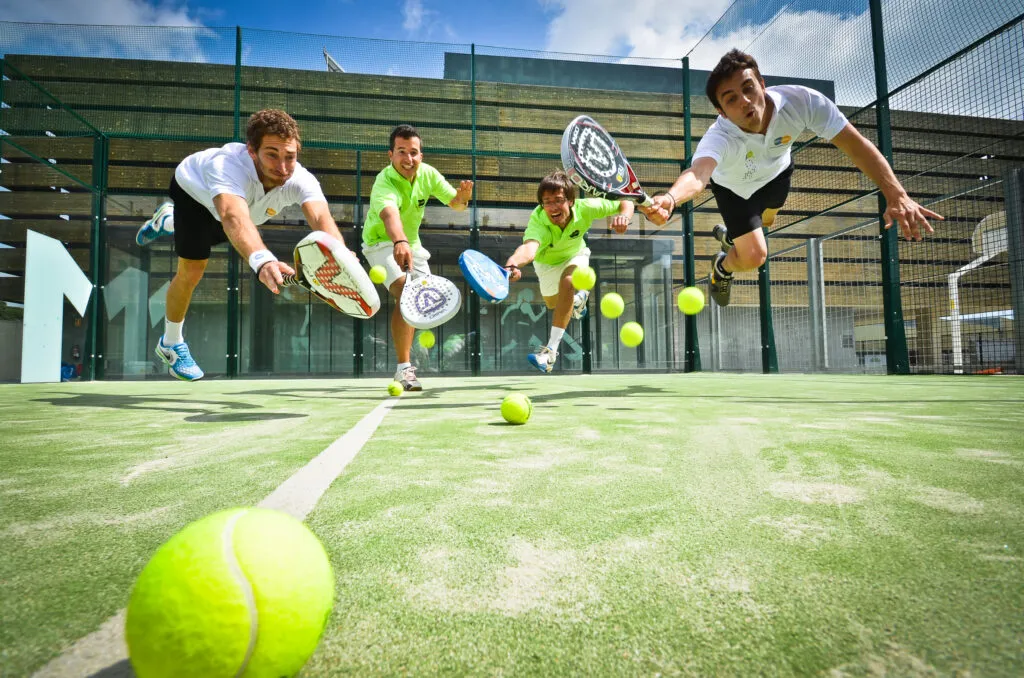
Communication and teamwork
Padel is structurally cooperative. Every point requires two players to coordinate – positioning, shot selection, covering each other’s space. Coaches commonly observe that the micro-interactions padel generates mirror workplace collaboration more directly than passive team-building formats. The sport creates genuine shared stakes rather than parallel participation.
Inclusivity across fitness and experience levels
Unlike football, which rewards baseline fitness, or tennis, which has a steep technical learning curve, padel welcomes participants of almost any background from the first session. The enclosed court, lower net height, and forgiving wall play reduce the intimidation factor for complete beginners. This inclusivity is one of the most frequently cited reasons HR managers in the UAE select padel over other corporate sport formats.
Cross-departmental connection
In a structured corporate padel event, participants from different departments are grouped into mixed teams and rotate across matches. This creates organic social contact between colleagues who may rarely interact in a standard office environment. The informal setting of a padel court lowers social barriers that are difficult to remove in meeting room formats.
Employee wellbeing
Padel provides moderate cardiovascular activity with lower joint impact than running or tennis. Many players report noticeable improvements in mood and energy following padel sessions. For organisations integrating sport into employee wellness programmes, padel is a commonly recommended format – physically meaningful without the injury risk of contact sports.
Strategic thinking under pressure
Padel rewards patience, positioning, and tactical awareness at least as much as physical power. The ability to adapt under mild pressure – adjusting a strategy mid-rally, anticipating opponent movement, staying composed in a tiebreak – is directly relevant to workplace problem-solving. This transferable quality is one reason padel team building is increasingly specified by learning and development managers alongside traditional leadership training.
Scalability across group sizes and budgets
Corporate padel events in the UAE can be organised for groups as small as eight participants on two courts, or scaled to full company tournaments with 60 or more players across multiple courts. Most major club venues across Dubai, Abu Dhabi, and Sharjah offer dedicated corporate booking arrangements that include equipment hire, coaching staff, and catering options.

How to organise a corporate padel event in the UAE: step by step
Step 1 – Define the objective
Before any other planning begins, identify the primary goal of the event. Common objectives include improving cross-team communication, boosting morale after a demanding project cycle, onboarding new employees, or providing a structured platform for client relationship development. The objective determines the format – a social mixer runs differently from a competitive mini-tournament, and both require different venue setups and briefing structures.
Step 2 – Decide group size and team composition
Each padel court accommodates four players at a time. A practical guide:
- 2 courts: suitable for approx. 8-20 participants with rotation
- 4 courts: suitable for approx. 20-40 participants
- 6 or more courts: larger events of 40 or more participants
For events with a team-building focus, deliberately mix departments and seniority levels when assigning pairs – pairing a senior leader with a junior colleague, or grouping people who do not normally collaborate. This is where the cross-departmental benefit is built in, not left to chance.
Step 3 – Choose a tournament format
Three formats are commonly used for corporate padel events in the UAE.
Round-robin – every pair plays every other pair once. Points accumulate and a final ranking is produced. This format maximises playing time for all participants and avoids early elimination. Recommended for most corporate events where inclusion is a priority.
Americano – players rotate partners after each match and accumulate individual points. This maximises social mixing because participants play alongside and against a wider range of colleagues throughout the session. Well suited to networking-focused or client events.
Knockout – pairs are drawn against each other and the loser is eliminated. Produces a clear competitive outcome but means some participants stop playing early. Best paired with a consolation bracket so eliminated pairs continue playing.
How pairs are assigned in each format:
- Round-robin: the organiser assigns fixed pairs in advance, typically mixing ability levels deliberately. Those pairs remain together for the full event.
- Americano: the organiser assigns opening partners. After each match, partners rotate according to a fixed system – typically the winning pair splits and each player takes a new partner for the next round. Individual points accumulate throughout.
- Knockout: the organiser assigns fixed pairs. Those pairs are placed into a drawn bracket and advance or exit depending on match results.
For most UAE corporate events with mixed ability groups, round-robin or Americano is the better choice over straight knockout.
Choosing a tournament format for your Corporate padel event
UAE-specific planning considerations
Climate and seasonality
The UAE’s climate divides the corporate padel calendar into two clear periods. October through to April is the optimal window for outdoor or covered courts. Between May and September, indoor air-conditioned venues are the only practical option for daytime events. Some venues offer early morning slots during transitional months, but this requires specific confirmation.
For more detail on playing padel in UAE summer conditions, refer to the playing padel in UAE summer guide and the indoor vs outdoor padel UAE guide.
Working week and scheduling
The UAE working week runs Sunday to Thursday in many organisations. Corporate events are commonly scheduled on Thursday afternoon or Friday morning. Some companies organise events during working hours mid-week; others prefer to keep the occasion outside office hours. The right choice depends on company culture and how the event is positioned.
Ramadan
During Ramadan, Muslim colleagues will be fasting during daylight hours. Corporate events involving physical activity require careful consideration of timing. Events scheduled after Iftar – the fast-breaking meal at sunset – are generally the most inclusive approach. Consulting with the team in advance and choosing a timing that works for the majority reflects well on the company’s cultural awareness.
Budget planning
The main cost categories for a corporate padel event in the UAE are:
- Court hire – the core cost, typically calculated per court per hour; multi-court exclusive bookings may attract a package rate
- Equipment rental – racket hire per participant for those without their own
- Coaching or facilitation – on-court coach or instructor for the orientation and match supervision
- Catering – pre-event refreshments, post-match food and drinks, or a full meal
- Prizes and awards – optional but commonly included; modest and flexible in cost
- Photography or videography – optional for internal communications or social media
Separating court hire and catering from discretionary items helps prioritise spending in line with the event’s purpose and available budget.
Common mistakes to avoid
Overloading the schedule – trying to fit too many rounds into a limited timeframe leads to rushed matches and frustrated participants. Build in realistic buffers between rounds.
Ignoring beginner needs – events that assume a moderate level of ability, or that group experienced players together while beginners struggle, leave newcomers feeling excluded. Ability-mixed teams and a proper briefing address this.
Booking without checking corporate facilities – not all padel venues in the UAE are set up for corporate group bookings. Confirm changing rooms, a space for gatherings, and adequate equipment rental before committing.
Scheduling outdoor events in summer without an indoor alternative – booking an outdoor venue in June, July, or August without confirming an indoor option is a common error made by organisers unfamiliar with UAE conditions.
Under-communicating with participants – a clear pre-event briefing is one of the most effective things an organiser can do. It costs nothing and significantly improves both attendance and the experience on the day.
What to do next?
Coaching introduction – a 20 to 30 minute coaching session at the start of the event helps beginner participants feel prepared and reduces initial awkwardness. Coaches can cover grip, ready position, the serve, and wall play in a group setting.
Mini-workshops – a short skills session during a break, focused on a specific shot or technique, adds variety for events running over a longer format.
Social or networking element – a post-tournament gathering with food and drinks extends the value of the event beyond the court and creates space for the most meaningful conversations – particularly for client-facing occasions.
Awards ceremony – a brief awards moment tied to a fun category alongside the competitive result keeps the tone celebratory and gives the event a clean close.