Padel for Children UAE: 7 Proven Benefits Every Parent Must Know in 2026
By the Padel Gameplan Editorial Team | Published: 21 March 2026 | Updated: 21 March 2026
Padel for children is one of the fastest-growing junior sport categories across the UAE in 2026. From Dubai and Abu Dhabi to Sharjah, Ajman, and Ras Al Khaimah, parents are increasingly enrolling their children in structured padel programmes – drawn by the sport’s accessible learning curve, its doubles format that naturally builds teamwork, and the wide availability of junior-specific coaching across all seven emirates.
This guide answers the parent decision questions that come before enrolment: Is padel right for my child? What age should they start? What are the real developmental benefits? Is it safe? What equipment is needed? And how does padel compare to tennis as a starting sport for children in the UAE? The content is based on widely accepted coaching methodology, junior sport development principles, and programme information verified at the time of writing.
For parents who have already decided to enrol and want to compare specific academies, class structures, and programme providers across Dubai, Abu Dhabi, and Sharjah, the Kids Padel Classes UAE guide covers all named programmes, costs, age ranges, and locations in detail.
For a broader introduction to the sport itself, the Padel for Beginners UAE guide provides useful foundational context.
What Age Can Children Start Padel in the UAE?
One of the most common questions parents ask is what age is appropriate to begin. Based on how junior programmes across the UAE are structured, the following age groupings are widely used by academies and coaching providers:
| Age Group | Stage | Typical Programme Focus |
|---|---|---|
| 4 – 5 years | Introduction | Racket familiarity, basic movement, foam balls |
| 6 – 7 years | Foundation | Simple technique, court awareness, adapted balls |
| 8 – 10 years | Development | Structured coaching, basic shot technique, game play |
| 11 – 15 years | Progression | Tactical awareness, match play, competition pathways |
| 16+ years | Junior – Adult | Transition to adult programme structures |
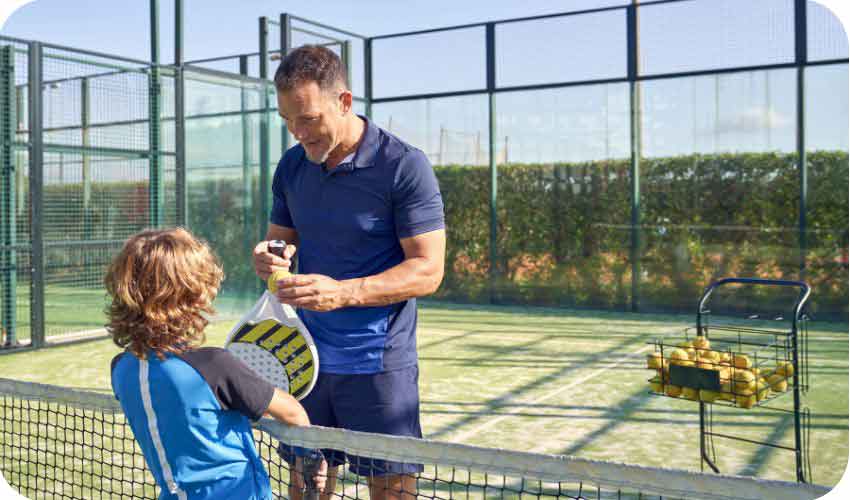
Most structured junior programmes in the UAE accept children from age 4 to 5 for introductory sessions using foam balls and lightweight mini-rackets, with formal coaching typically beginning from age 6 to 7 onward. Many coaches note that the appropriate starting age also depends on individual coordination and attention span rather than age alone.
Social play with family on a standard court is common for younger children even before formal coaching begins. The sport’s enclosed court format and lightweight equipment make early exposure both safe and practical.
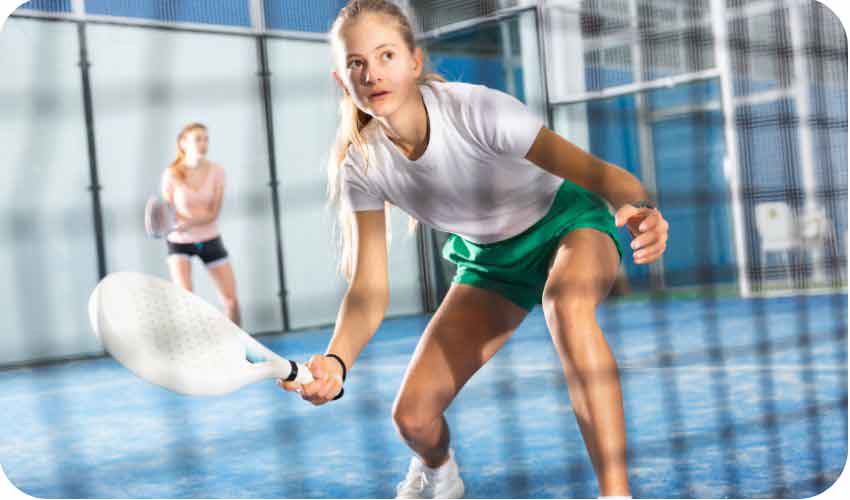
Padel by Age Group: What to Expect at Each Stage
Ages 4-5: Introduction and Racket Familiarity
At this stage, the focus is almost entirely on physical coordination and getting comfortable with a racket. Sessions use softer, low-compression balls and are play-based rather than technique-driven. No formal rules are introduced. The goal is enjoyment and basic motor development.
- Sessions typically run approx. 45-60 minutes
- Equipment is usually provided by the programme
- No prior sports experience is required
Ages 6-7: Introductory Padel Skills
Children in this group begin learning the foundational padel strokes – forehand, backhand, and basic volleying – using adapted balls suited to their coordination level. Simple court positioning is introduced. Social interaction with peers is a major component of sessions at this stage.
- Sessions typically run approx. 60 minutes
- Coaches commonly use visual cues and games to teach contact point and stance
- Junior rackets and lighter balls are standard
Ages 8-11: Structured Coaching Begins
From age eight onwards, children are generally ready for structured coaching sessions that introduce recognisable padel technique, serving rules, basic scoring, and simple match play. This is when most UAE academies begin their formal junior curriculum.
- Sessions typically run approx. 60-90 minutes
- Progressions cover grip, ready position, footwork, serve mechanics, and wall awareness
- Friendly internal tournaments and social match formats are often introduced
Ages 12-15: Intermediate Development and Competition Pathways
Older juniors work on refining technique, developing tactical awareness, and preparing for organised competition. Content at this level typically includes directional shot control (crosscourt and down-the-line patterns), introduction of overhead shots including the bandeja, doubles positioning and court coverage, and match analysis with simple tactical frameworks. Many UAE academies at this level operate in skill-tiered groups, separating players by ability rather than age alone.
Ages 16+: Advanced Junior and Academy Transition
Players at this stage may be preparing for competitive junior tournaments or transitioning into adult social and club play. Coaching focuses on consistency under match pressure, advanced tactical concepts, and physical conditioning relevant to padel movement.
7 Proven Benefits of Padel for Children
1. Physical Development and Fitness
Padel supports a broad range of physical skills that are important during childhood development. The sport involves constant lateral movement, direction changes, reaching, and short sprint efforts – all of which develop cardiovascular fitness, muscular coordination, and agility.
Coaches commonly highlight that padel’s movement patterns develop skills relevant to many other sports, including footwork, spatial awareness, and hand-eye coordination. Because the court is smaller than a tennis court and rallies are naturally supported by wall play, children tend to stay active throughout the session rather than spending time waiting or chasing balls outside the court.
2. Hand-Eye Coordination
Tracking a moving ball, judging its speed and trajectory after wall rebounds, and making contact with a racket at the correct moment is one of the most effective exercises for developing hand-eye coordination in children. Padel’s enclosed glass and mesh walls mean the ball remains in play more consistently than in tennis or other racket sports, giving children more contact opportunities per session.
Coaches working with junior players commonly note that children who struggle with coordination in other sports often find padel more manageable because the court size and slower ball speed at beginner level reduce reaction time pressure while still providing genuine athletic challenge.
3. Teamwork and Communication
Padel is played in doubles format in most junior programmes. This means children must communicate, share court responsibility, support their partner, and make joint decisions during every point. These are genuine teamwork skills that transfer beyond the court into school and social settings.
Many parents report that the doubles format is one of the primary reasons they chose padel over individual racket sports for their children. The paired structure reduces the isolation that some children experience in individual sports and naturally encourages communication from the very first session.
4. Confidence and Resilience
The structure of padel – where points are short, rallies are frequent, and improvement is visible quickly – provides children with regular, achievable milestones. Learning to serve, rally, and win a point produces tangible results that build confidence at a pace many children find more accessible than sports with longer skill development curves.
The short nature of each point also teaches resilience. After a lost point or a mistake, the next rally begins immediately. Coaches working with junior players commonly note that this rhythm helps children practise moving past setbacks quickly – a skill valuable both in sport and in broader life.
5. Social Engagement and Inclusion
Padel’s doubles format naturally creates a social environment. Children play with and against others of similar age and level, and many junior programmes incorporate structured group sessions where multiple pairs rotate partners. This exposure helps children build friendships, develop social confidence, and practise interaction with peers from diverse backgrounds – particularly relevant in the UAE’s multicultural community environment.
Mixed-gender and mixed-nationality groups are common in UAE junior padel programmes, reflecting the sport’s broad appeal across the region’s Arabic and expat communities alike.
6. Safety and Low Injury Risk
The padel court’s enclosed design significantly reduces the risks associated with many outdoor sports. Balls remain within the court boundary. The sport does not involve physical contact. The underhand serve and smaller court mean that balls travel at lower speeds than in tennis during beginner play, reducing impact-related injury risk.
Many parents and coaches note that padel’s enclosed, smaller-court format is one of the safest racket sport environments for younger children. Compared with sports involving higher-speed balls, physical contact, or open outdoor spaces, padel provides a well-contained, structured play environment.
7. Accessible Learning Curve
Unlike tennis, where the technical demands of the serve and groundstrokes can frustrate young beginners, padel’s underhand serve, smaller court, and wall-supported rallies mean children can sustain longer rallies and experience success much earlier in the learning process. This early sense of achievement is widely cited by coaches as a key factor in children staying engaged and returning to training.
Many parents report that their children were able to rally successfully within their first few sessions – an experience that is less common in tennis at the same age and skill level. The accessible entry point makes padel particularly suitable for children who may have had negative experiences with more technically demanding sports.
What Equipment Does a Child Need to Start Padel?
Getting started does not require significant equipment investment, particularly as most junior programmes provide equipment during sessions for younger beginners.
Some product mentions may include affiliate links. The following table outlines what is typically needed:
| Equipment | What to Look For | Notes |
|---|---|---|
| Junior padel racket | Lightweight (200-280g), smaller grip, appropriate length for age | Many programmes provide rackets during sessions |
| Padel balls | Standard or low-compression balls depending on age | Often provided by the programme |
| Sports shoes | Good lateral support, non-marking sole | Padel-specific or multi-court shoes recommended |
| Sportswear | Breathable, flexible, moisture-wicking fabric | Standard athletic clothing is suitable |
| Water bottle | Insulated, adequate capacity for UAE heat | Essential year-round, especially in summer months |
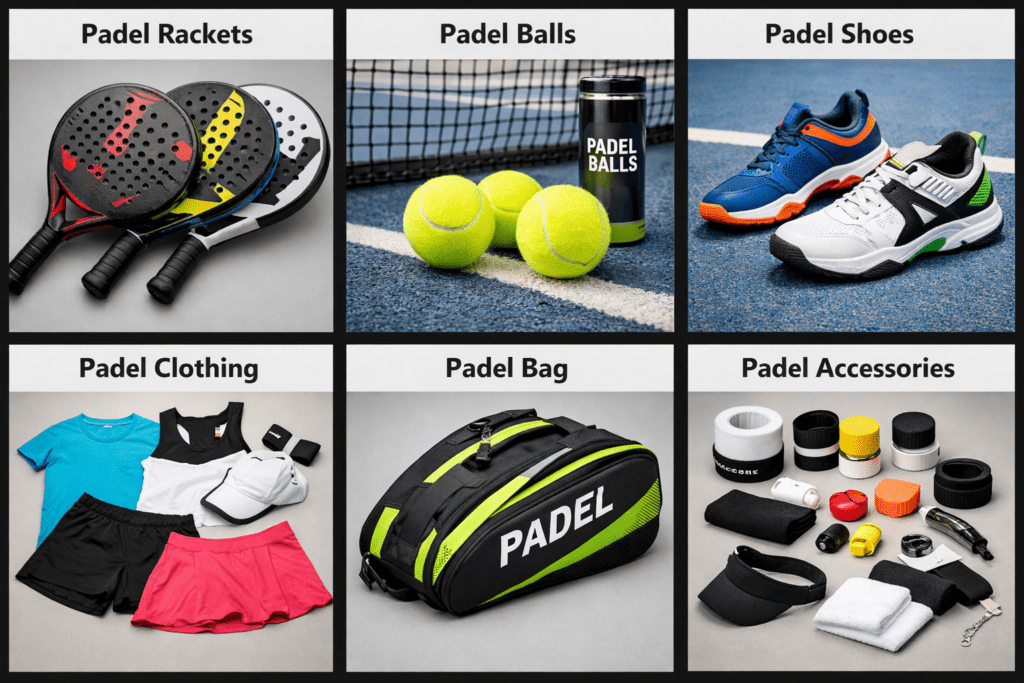
For detailed racket guidance by age and size, the Padel Rackets section covers specifications and options available in the UAE. A full equipment checklist is also available in the Padel Equipment Checklist article.
Coaches commonly recommend that parents avoid purchasing high-specification or expensive rackets for young beginners. A lightweight, appropriately sized junior racket is more important than brand or material specification at the early stages of development.
Padel for Children vs Tennis: A Practical Comparison for UAE Parents
Many parents considering padel for their children are also evaluating tennis. Both are excellent racket sports, but there are meaningful differences that affect suitability for younger or beginner players.
| Factor | Padel for Children | Tennis for Children |
|---|---|---|
| Learning curve | More accessible – walls support rallies | Steeper – serve and groundstroke technique more demanding |
| Court size | Smaller – less intimidating for young players | Larger – more ground to cover |
| Serve technique | Underhand – simpler for beginners | Overhand – more technically demanding |
| Social format | Always doubles – built-in teamwork | Singles and doubles – more individual |
| Ball speed (beginner level) | Slower with adapted balls | Can be faster at equivalent age group |
| Physical demand | Moderate – short active intervals | Can be higher in singles format |
| UAE availability | Rapidly expanding – 300+ courts nationwide | Well-established – significant infrastructure |
Both sports coexist across UAE clubs, and many families report that children who begin with padel later develop an interest in tennis as well. The sports are complementary rather than competing options. Padel’s more accessible early experience means children tend to achieve visible results more quickly – a factor many coaches and parents identify as significant for maintaining long-term engagement.
How Junior Padel Programmes Are Typically Structured
Junior padel programmes in the UAE typically follow a term-based structure with weekly sessions of approx. 60 to 90 minutes. Children are grouped by age and skill level, and the curriculum progresses through defined stages from racket familiarisation through to game play and eventually match competition.
Most reputable programmes use adapted balls – lower compression or foam – for younger age groups to slow the game and allow more successful contact during early skill development. Coaches commonly note that the single most important structural feature of a quality junior programme is grouping children by both age and skill level, not age alone. A beginner child aged 10 placed in a group of experienced 10-year-olds will not progress effectively.
For detailed comparisons of specific named programmes, academies, their formats, locations, age ranges, and costs across Dubai, Abu Dhabi, Sharjah, and other emirates, the Kids Padel Classes UAE guide covers all options in a structured directory format.
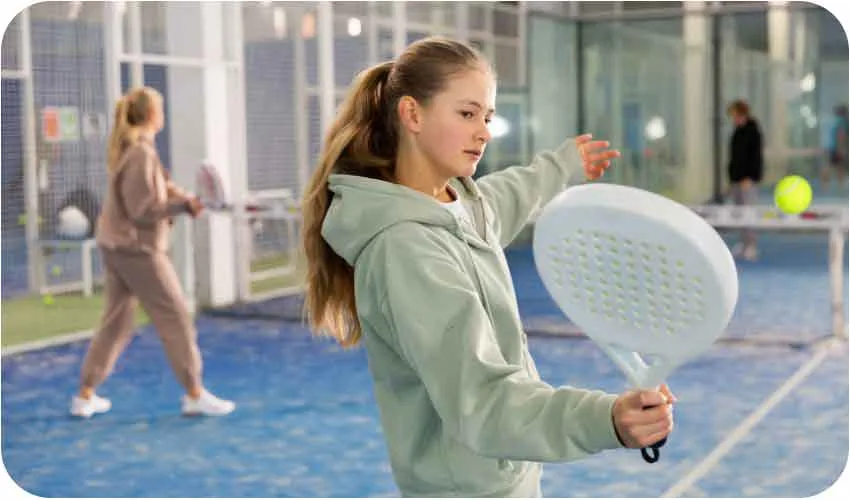
Playing Padel During UAE Summer: Practical Advice for Families
The UAE’s climate requires specific consideration for junior sport participation, particularly from May through September when outdoor temperatures regularly exceed 40 degrees Celsius.
Most established padel venues across Dubai, Abu Dhabi, Sharjah, and other emirates offer indoor, air-conditioned courts that allow year-round play regardless of outdoor temperature. Many junior programmes operate exclusively indoors during summer months, with outdoor sessions typically reserved for the cooler period from October through April.
Practical guidance for parents during warmer months:
- Ensure children are adequately hydrated before, during, and after sessions. Dehydration is a significant risk during physical activity in the UAE climate and should not be underestimated regardless of whether sessions are indoors.
- Choose venues with confirmed air conditioning for any session during the May to September period.
- Schedule sessions during early morning or evening hours if outdoor play is involved during transitional months such as April and October.
- Breathable, moisture-wicking sportswear is recommended year-round. The Padel Clothing article covers suitable options available in the UAE.
Many junior programmes in the UAE structure their term calendar around the UAE school year, with the highest-intensity periods running from September through December and January through March – the most comfortable months for physical activity.
Is Padel Worth Starting for Your Child in the UAE in 2026?
Based on the developmental evidence, the sport’s structure, and the availability of junior programmes across the UAE, padel is a strong choice for most children from age 4 to 5 upward. The combination of accessible technique, natural teamwork through the doubles format, consistent physical activity, and rapid early achievement makes it particularly suitable for children who are new to structured sport.
The UAE’s padel infrastructure – with over 950+ courts across 320 venues nationwide as of 2024 as reported by FIP, with continued rapid expansion annually – means access is no longer a barrier for most families across Dubai, Abu Dhabi, Sharjah, and the Northern Emirates. Indoor air-conditioned options make year-round participation viable regardless of season.
For parents who want to explore coaching and improvement options beyond junior-specific programmes, the Padel Coaching UAE and Padel Lessons UAE guides cover adult and family-level coaching services available in 2026. For serve technique guidance relevant to children progressing beyond beginner level, the Best Padel Serve Techniques article provides a structured overview.
10 Frequently Asked Questions: Padel for Children UAE
1. What is the right age to start padel for children in the UAE? Most junior programmes accept children from age 4 to 5 for introductory sessions. Formal structured coaching is typically available from age 6 to 7 onward. Individual coordination and attention span influence readiness as much as age.
2. Is padel safe for young children? Yes. The enclosed court design keeps balls within the boundary, eliminates outside collision risks, and reduces impact risk compared with higher-speed sports. The underhand serve and slower ball speeds at junior level further support safety. Standard sport precautions including warm-up and hydration apply.
3. Does my child need prior racket sport experience to start padel? No. The vast majority of UAE junior programmes accept complete beginners and teach all fundamental skills from scratch. No prior tennis or other racket sport experience is required.
4. How does padel benefit children’s development compared to other sports? Padel simultaneously develops hand-eye coordination, lateral agility, cardiovascular fitness, teamwork, communication, and resilience within a single sport session. The doubles format integrates social skill development into every point, which is less structured in individual sports. The accessible learning curve means children experience success and achievement earlier than in many comparable sports.
5. Can children play padel during UAE summer? Yes, provided the venue has indoor air-conditioned courts. Most established padel clubs across Dubai, Abu Dhabi, Sharjah, and other emirates offer indoor facilities suitable for year-round play. Parents should confirm air conditioning availability before booking summer sessions.
6. What equipment does my child need to start padel? A junior padel racket appropriate for the child’s age and size, suitable sports shoes with lateral support, and breathable sportswear are the primary requirements. Many junior programmes provide rackets and balls during sessions for younger beginners, reducing the need for immediate equipment purchase.
7. Is padel better than tennis for children as a starting sport? Both sports offer significant developmental benefits. Padel’s smaller court, underhand serve, and wall-supported rallies generally make it more accessible for younger beginners, allowing children to rally successfully earlier. Many children who begin with padel also develop an interest in tennis over time. The choice depends on the individual child’s preferences and available local provision.
8. How long does it take a child to learn padel? Most children achieve consistent rally play and basic scoring understanding within 8 to 10 weeks of weekly beginner sessions. Confident match play in social formats typically develops after 3 to 6 months of consistent weekly coaching. Competitive readiness at junior tournament level requires 12 months or more.
9. Are there padel competitions for children in the UAE? Yes. Junior tournaments are organised at club and federation level across Dubai, Abu Dhabi, and other emirates. Age-category divisions typically begin from under-10 groupings. Parents should speak with their child’s coach about when competitive participation is developmentally appropriate.
10. Where can I find the best junior padel classes across the UAE? The Kids Padel Classes UAE guide provides a full directory of named academies and programmes across Dubai, Abu Dhabi, Sharjah, and beyond – including age ranges, formats, locations, and cost information.
Published by the Padel Gameplan Editorial Team. Content in this article draws on the following references, consulted at time of writing in 2026. Sources include the Emirates Golf Club Junior Padel Programme, the Viya Padel Junior Group Programme, Central Padel Dubai Junior Academy, Premier Sports Academy Junior Padel Programme, the McDonald’s Junior Padel Academy UAE, and WPA Junior Padel Academy.
Programme structure and age grouping references are informed by the International Padel Federation Official Game Regulations and the Gulf Today report on WPA junior and adult training programmes. Market context draws on the Dubai Active UAE padel industry overview, PadelSkillCards on padel growth in the UAE, and Club Padel UAE on why padel is popular in the UAE. Parents should confirm current programme availability, pricing, and term schedules directly with each provider, as details change regularly.